Aikatsu! and the Power of Not Running Jokes into the Ground

WARNING: Spoilers
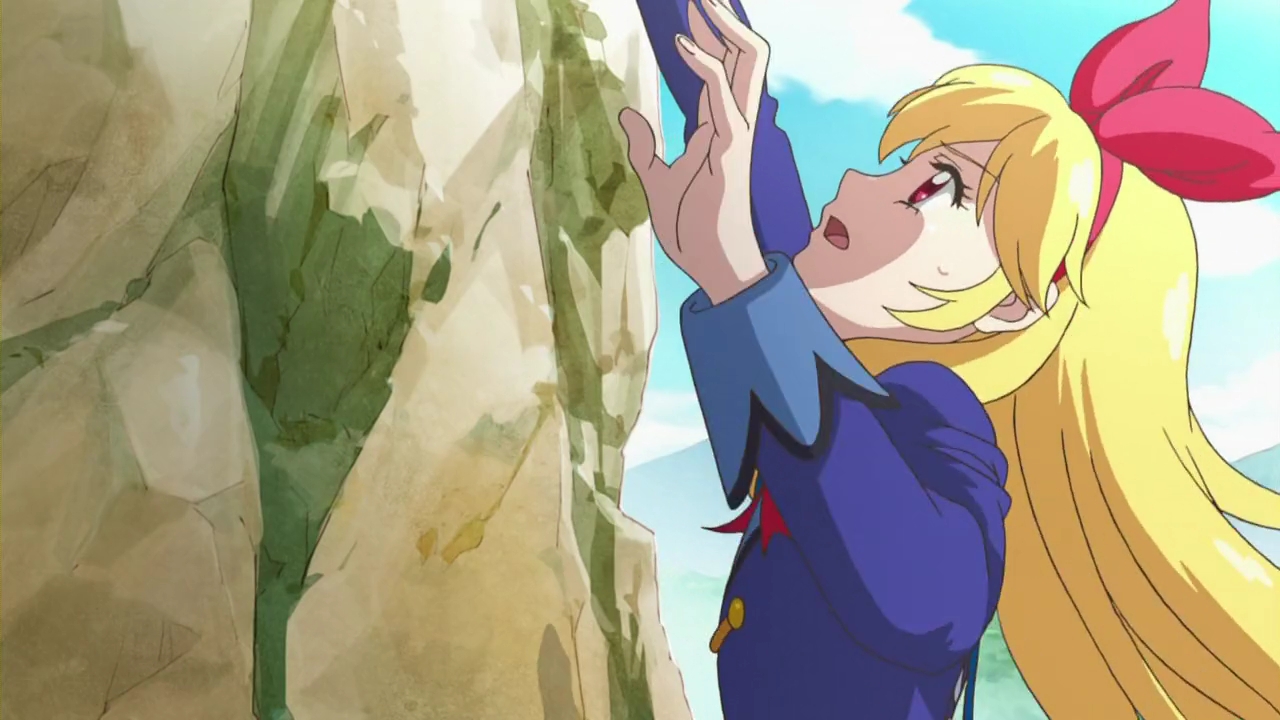
For all of their abundant, game-shilling elements, the Aikatsu! anime have done a remarkably good job of standing on their own. Whether it’s Ichigo or Akari from the first series, or Yume from Aikatsu Stars!, the franchise creates fun, interesting protagonists and then surrounds them with a large cast of equally charismatic and compelling characters. Another important quality of Aikatsu! is that it excels at not letting any of its running jokes overstay their welcome, which is best seen in how it handles its famous “cliff-scaling” gag.

In an early episode of Aikatsu!, Ichigo tries to get in contact with a world-famous fashion designer who lives atop Angely Mountain. Ichigo, willing to do whatever it takes, ends up climbing all the way up, unaware of the fact that she could’ve taken an elevator. After meeting the fashion designer, Ichigo goes on to view her as a guiding voice of sorts, someone to ask for advice. And every time she visits, she takes the hard way.

Ichigo’s “pilgrimage” is not overused. It doesn’t show up every episode, or even every other episode. Every time that mountain shows up, it’s an opportunity to laugh but also to view progress. Eventually, Ichigo climbs it with such ease that it becomes symbolic of her drastic improvement as an idol. I knew that, whenever that cliff showed up, I would smile with glee.

Not every running joke is used as sparingly. Yurika’s vampire gimmick is prevalent. Even here, however, the frequency with which Yurika plays up her faux-occult origins becomes part of the humor. Because Yurika works hard to maintain what pro wrestlers call “kayfabe” (essentially living the role), it becomes one of her endearing qualities. Her constant refrain of “I’ll suck your blood!” is presented as one of the many reasons Yurika’s fans love her.

When it’s revealed late in the first season that Ichigo’s mother is a legendary idol, nothing is more perfect than the further revelation that Hoshimiya Ringo is already well accustomed to visiting Ichigo’s designer. “It’s been a long time since I’ve done this,” she says, ready to climb. The cliff-scaling is not a gag exclusive to Ichigo, but actually permeates the entire idol universe of Aikatsu! 

In one of the later openings, Akari (Ichigo’s successor as heroine) can be seen climbing along with her friends. Thanks to the context established by Ichigo, the scene encapsulates what’s great about Aikatsu!, instead of feeling like a callback to a worn-out image.

This post was sponsored by Johnny Trovato. If you’re interested in submitting topics for the blog, or just like my writing and want to support Ogiue Maniax, check out my Patreon.

Chala Head Chala vs. Rock the Dragon and the “Image” of Dragon Ball Z

In a recent blog article, I wrote about how the character of Vegeta in Dragon Ball Z is portrayed differently in Japanese and English, and how this has resulted in something of a divide among fans. The article was a surprising success, quickly becoming one of my most popular posts in recent memory, and the numerous responses I received (especially on Twitter) prompted me to think more about how Dragon Ball Z (and the Dragon Ball franchise in general) is perceived differently depending on how a person came across it.

Is Dragon Ball a gruff fighting series, or a heartful adventure? How big a role should comedy play before it goes too far? Many factors go into how the series is viewed, including whether or not someone started with adult or kid Goku, but I came to realize another influence: theme songs. On some level, I believe that the core difference between how Dragon Ball can be summed up in the contrast between “Rock the Dragon” and “Chala Head Chala.”

Before I delve more deeply, I do want to say that, while I prefer “Chala Head Chala,” my taste in music is not important here. Nor is the fact that “Chala Head Chala” came first. Tthe anime is based on the manga, which has no actual sound at all, let alone opening and ending themes. “Being the original” is not a sound argument to make. What I will be focusing on is mainly, how do each of those themes make its viewers feel?

“Chala Head Chala” feels fairly light-hearted, with quite a few odd lyrics (“If I discover a dinosaur in ice, I want to balance it on top of a ball” ???), yet there’s also a quiet sense of gravitas thanks to Kageyama Hironobu’s warbling voice. While the theme does suggest action and excitement, it emphasizes more a sense of “adventure” and “discovery,” though perhaps not to the same extent as the Dragon Ball opening, “Makafushigi Adventure.” Most of the visual imagery in the opening is concentrated on movement—flying and running. Motion is the key.

“Rock the Dragon” is all about heavy use of electric guitar riffs. The song puts all of its emphasis on high-octane thrills, and the the lyrics (as repetitive as they are) further push to the forefront the idea that this is not just a series with action, it’s the action series. Instead of the first image being a rotating dragon ball, it’s the dragon itself in all of its majesty and glory. All of the footage aside from that is fighting, fighting, and more fighting.

If I had to greatly simplify, I’d say that “Rock the Dragon” is more about “body and spirit,” and “Chala Head Chala” is more about “heart and soul.” They both introduce the same overall series, about Goku and his allies taking on ever-increasingly powerful threats to the Earth, but one revels in the fighting and the other suggests fighting as a means of expressing character. Because of this difference, I think it cements different core images of Dragon Ball in people’s minds, and this affects how subsequent works (Battle of Gods, Dragon Ball Super) are received as well. Looking ahead, the opening of Dragon Ball Super, “Limit Break x Survivor,” is actually a kind of middle point between “Chala Head Chala” and “Rock the Dragon” with a dash of “Makafushigi Adventure.” Could it be the theme that unites Dragon Ball dub and sub fans once and for all?

Bootleg Products and the Defiance of Value

Growing up in New York City, bootleg products have always been a common sight. Whether it’s Louis Vitton bags, cashmere scarves, DVDs, or even plastic anime models, one could easily find a lower-cost (and lower-quality) version of whatever “big thing” was out there. Given that these products are often shoddily made, violate intellectual property rights, and in some cases actually fund organized crime, it’s very understandable why the official companies whose products are being bootlegged would take umbrage with the existence of knock-offs. However, putting aside the questions of both legality and quality, I’ve begun to wonder if bootleg products serve a certain function in a consumerist, capitalist, and image-driven society.

I recently read the book Hillbilly Elegy by J.D. Vance, a memoir about growing up as a hillbilly in Appalachia. At one point, Vance mentions how many hillbillies are very bad at properly budgeting their money, and they will use their welfare checks to buy expensive products like smartphones and cars instead of for necessities. This is also a common story among people in the inner city, and in Korea they have a term: doenjang girl, or someone who cuts out essentials so they can buy luxury items. In all of these cases, there’s more to this behavior than simply trying to cheat the government, or starve oneself. In actuality, it has a lot to do with trying to chase the image of prosperity, to live as a “have” even if one is a “have-not.”

To state a truism, expensive things are expensive. They add up. The role of bootleg products, then, is that they allow people who cannot afford (or do not want to buy) the products the full price to at least obtain a facsimile. Sales, discounts, and even big box stores all fall along this general trend, but rarely can they compete with the rock-bottom prices of bootlegs because they’re beholden to things like laws and standards. If expensive, name-brand goods carry with them the image of success and fine living, then bootlegs are the shortcut that allows someone with less to access that fantasy without having to sacrifice everything else. Of course, many of these products are luxuries and therefore unnecessary. However, because of how much people value image and social capital, they can become more important than even food and shelter in a certain sense.

There are two different types of consumers of bootleg products: those who know they’re buying bootlegs and those who don’t. The latter are more uninformed victims. I know I’m not the only one who bought those “Son May” anime CDs back in the day, and the counterfeit Nendoroids keep improving their box designs to fool people. For the former, the surface image presented by someone who can show to the world (and to themselves) a version of oneself as living a “properly prosperous lifestyle” is enough.

Things are a little different when it comes to digital products, such as streaming anime or movie torrents. Strictly speaking, one does not wear or display their illegal streaming site episodes like one would a bootleg necklace, but there is a certain gain in “knowledge” and “status” as a result of consuming these products. Watching Game of Thrones through “alternative means” allows someone who wouldn’t be able to keep up with the buzz surrounding that series and thus keep up with conversations concerning GoT. On the podcast Comic Books Are Burning in Hell, that, the hosts discuss the concept that scans of comics allow a greater number of people to become experts on comics because it reduces the economic barrier to that amount of knowledge. [Unfortunately I can’t remember the episode, if anyone knows, please tell me!]

Regardless of the ethics of buying counterfeit products, bootlegs (even ones that are not physical), carry consequences beyond simply the damage they cause to creators and owners. They act as shortcuts to public image, emotional satisfaction (in terms of living the “proper” lifestyle), and even expertise. As a result, for better or worse they defy the prices for products set by companies and proprietors, while also reinforcing the images of those products as premium items.

[APT507] The Legacy of All Might: Pieces of the Symbol of Peace

My Hero Academia continues to impress, and I thought I’d write an article over at Apartment 507 concerning how different characters interpret and emulate All Might. If you have any thoughts on All Might as a character, let me know!

Tiger Mask W and the Lack of Friendship Redemption Arcs in Pro Wrestling

WARNING: Tiger Mask W spoilers

My decision to watch the anime Tiger Mask W came during a time that I’ve been watching more pro wrestling than I have in more than a decade. As I’ve re-acclimated myself to that world of holds, slams, betrayals, and glory, it only makes sense that a wrestling anime would hook me. The fact that it’s a sequel to a beloved classic that tries to capture the feel of the original but projected through the lens of today made that doubly possible. Watching Tiger Mask W and its story of revenge and redemption, however, made me extremely aware of the fact that real pro wrestling has plenty of the former but little of the latter.

One of the main plot points of Tiger Mask W is the rivalry between Tiger Mask and Tiger the Dark, two friends seeking vengeance on a common foe yet who aren’t aware of each other’s true identity. Eventually, they make amends and they grow stronger for it. This sort of narrative is incredibly common in anime and manga—think Naruto and Sasuke. In comparison, pro wrestling has backstabbing and teams imploding galore, but I can only think of very few cases where the reforging of bonds once broken actually seems planned in advance.

For example, over the past year, numerous duos in the world of the WWE have come apart when one character turns traitor. Kevin Owens attacked Chris Jericho during a celebration of their friendship. Tommaso Ciampa assaulted Johnny Gargano, ending the tag team DIY. Goldust hit R-Truth from behind, breaking up their alliance. Big Cass booted Enzo Amore in the face with disdain. All were and are meant to lead to feuds between former allies, the aftertaste of betrayal making them that much more bitter. Wrestling seems to be very much about building up teams only to tear them down and start an intense battle between the two, but actually bringing them back together is never part of the plan, at least not at first.

There’s always the chance that wrestlers will make amends. Perhaps one day Enzo will be fighting against the odds, when Cass runs out and saves him. After all, face turns (switches from evil to good) are part and parcel with the industry. But they’re not woven into the narrative from the start so much as something that’s done once a rivalry has run its course. They’re treated as two separate stories: the betrayal that occurs, and then later (if they really need it) the redemption and reunion.

But I want my “anime as hell” stories about a hero trying over and over to rescue a former friend from the darkness. I want face turns to come from realizing the errors of one’s ways. I want more Tiger Mask and Tiger the Dark narratives. I don’t want the restoration of friendship to be an afterthought, but something actually planned as part of a greater arc.

The Fun of Farming Games (Except Farmville)

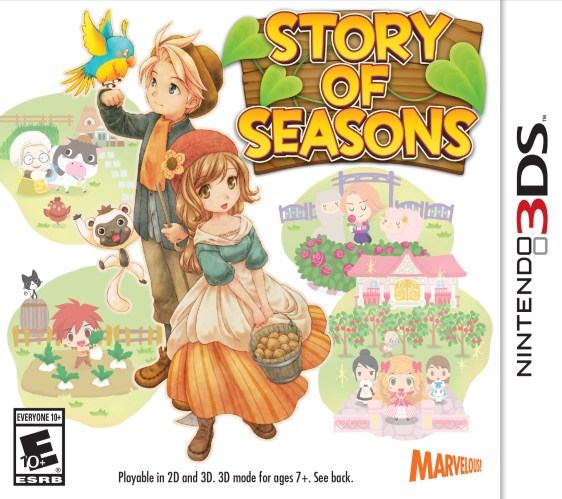
Until recently, I never played farming-themed video games. The closest I ever came to it was basically growing berries in Pokemon. Ever since I began to play the 2014 Story of Seasons for the 3DS (previously known as Harvest Moon), however, I think I’ve come to understand the appeal of farming simulators, and to whom they hold the greatest attraction.

The first thing I noticed is how much there is to keep track of. You’re quickly told about different plants, traders arriving on certain dates, certain items being more valuable in different seasons, birthdays, all while trying to make sure you’re watering your crops and feeding your livestock. Thankfully, the game is not based on a real clock and therefore does not require you to perform chores based on time in the real world—something that was a pain in some Pokemon entries. What’s more, balancing the crops you eat to survive vs. the crops you sell seems tricky, and makes me wonder how actual farmers find that sweet spot.

Being as successful as possible requires not only intimate knowledge of the game’s farming mechanics, but also diligence and the ability to plan far in advance. In other words, farming as a game is ideal for people who thrive on creating and maintaining a schedule, and excel in efficiency. While the farming setting is fairly laid back and I’m not sure it’s possible to squeeze every last second for all it’s worth, proper planning is the domain of virtual agriculture.

The topic of farming games brings to mind the deadly specter that is the dubious “king” of the genre, Farmville. As once the most notorious of the Facebook social games out there, Farmville has been criticized harshly for basically exploiting its player base by both getting them addicted to the constant need to pay attention to the game, and for bilking them of their money by making the experience one that relies on negative reinforcement. However, I think that this does not necessarily apply to all farming-themed games, and a comparison to Story of Seasons shows the difference between a game where managing the ins and outs of a farm can be a positive and enriching experience, and one that leads down a long, dark path.

In Story of Seasons, as you get better at the game, you are not only able to do more, but there’s a greater sense of efficiency. By playing as best as you can, you spend the least amount of time necessary on a given task. Alternatively, you spend as much time as is enjoyable for you. In Farmville, however, the main function of the gameplay is to be a “time waster,” not just in the sense that it’s something you do in your free time, but that the game keeps its players glued to the screen for as many hours as possible. One rewards you for playing more by allowing you to do more, the other punishes you for not putting in as many hours as everyone else.

The Farmvilles of the world can go to hell, for they show how the fun of a genre can be corrupted, but perhaps they can lead people back to less exploitative examples. I get the charm of farming games as a kind of stress relief by way of meticulous micromanagement. I feel a simple joy in seeing my turnips fully grown and ready to be picked, and thinking about how to best use them is its own interesting strategy. There are elements that I wish were more automated, but even that brings its own strange catharsis. It’s as if stress and relaxation are balanced on a knife’s edge, a feeling I imagine might also come from a real farm.

This post was sponsored by Johnny Trovato. If you’re interested in submitting topics for the blog, or just like my writing and want to support Ogiue Maniax, check out my Patreon.

When Kirito Met Marcus Fenix

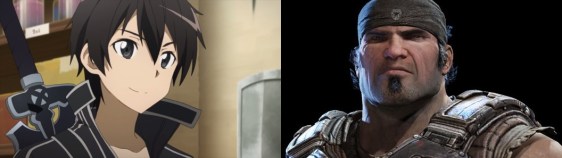
When looking at the generic male protagonist found in light novels, one finds that he usually has some combination of the following traits. First, he’s a guy. Second, he’s Japanese. Third, he has short hair. Fourth, he has a fairly slender figure. Fifth, he has either minor or major otaku vibes. Sixth, he has some trait that speaks towards passiveness, whether it’s an aspect of his personality or some sort of special ability that emphasizes defense or neutralization. Titles that fall along this criteria include Sword Art Online, Ore Imo, A Certain Magical Index, Baka Test, Re:Zero, Rise of the Shield HeroBakemonogatari, and so on. In effect, the Light Novel Protagonist plays a similar role to the “gruff brown-haired white guy,” an archetype that has populated mainstream video games over the past ten years.

The Light Novel Protagonist’s appearance renders him the “everyman,” but taken to a kind of extreme mediocrity. His appearance is roughly that of a teenager or early 20s adult who could probably pass for a salaryman if not for his clothing and lack of a stable job. Even though he’s often a “failure” in the eyes of society, he’s ready to show himself as capable if given the right (often nerdy) circumstances. In this way, the Light Novel Protagonist resembles the Video Game Hero in that both reinforce a rough image of masculinity. Where they differ is that the Light Novel Protagonist is often a kind of “bare minimum” of manhood, while the thick-necked rugged white guys of video games are the apex of masculinity in that arena.

This difference is evident when looking at how generic light novels and generic mainstream video games approach the topic of homosexuality. Putting aside a few exceptions from both sides, the protagonists of light novels are more willing than their angry, shooting counterparts in games to dance the line when it comes to gender. Kirito’s video game avatar gets long hair in later parts of Sword Art Online. Hachiman in My Youth Romantic Comedy and Akihisa in Baka Test find themselves attracted to extremely effeminate male characters. However, not only is the possibility of a homosexual ending unlikely, but the sheer femininity of those ambiguous characters’ appearances renders them essentially girls in all but name. As a result, masculinity and heterosexuality are preserved.

Nevertheless, that difference between portraying a masculine world versus a hyper-masculine world seems to be what allows light novels to attract a female audience a little more easily. This is actually something girls have learned to do for a long time, navigate the “boys’ world of entertainment” and carve out their own spaces, but games like Gears of War seem to actively reject any notion of appealing to people beyond their assumed young, male, heterosexual audience. In contrast, light novels pull from the many tropes of anime, manga, and Japanese games, which exist in a complex relationship of pulling aspects of girl-oriented titles toward male audiences and vice versa (e.g. shounen sports being made for girls, magical girls being made for guys).

The irony might be that, while both the Very Japanese Light Novel Protagonist and the Gruff White Video Game Hero are all about protecting their audiences’ masculinity, the two archetypes probably would not get along if they had to interact with each other. The video game hero is an embracing of old ideals of manliness, while the light novel protagonist tends to be a partial rejection of the former. The Light Novel Protagonist is often a “loser,” while the Video Game Hero is more frequently a “winner,” and the active acknowledgement of both might just be two different approaches to dealing with male insecurity.

Save

Why Consuming Melee is Like Eating Super Spicy Food

As a general fan of Smash Bros. I enjoy watching almost every game, but I prefer Smash 4 above all else. However, I’ve noticed that, if I watch Smash 4 after a couple hours or more of Melee, Smash 4 just seems to move muuuch mooore slooowly. If you’ve played a game with a speedy mode, like the Dodrio Tower in Pokemon Stadium, 8-star turbo in Street Fighter II Turbo: Hyper Fighting, or indeed even Lightning Melee in Smash Bros. Melee, this is probably a familiar feeling to you once you switch back to the default. While I know in my head that the decision-making in Smash 4 is plenty quick, I find that it takes a bit of time to re-acclimate my brain to Smash 4 from Melee.

I have no studies or evidence beyond my personal experience, so I’m not writing from a place of thorough research, but I don’t think I’m alone in feeling this way. What’s more, I suspect that, for those who are less interested in Smash 4, the effect is likely exacerbated.

In this respect, Melee reminds me a lot of super spicy food. Like Melee, spicy food has its diehard enthusiasts. If you like chilis and scoville ratings in the hundreds of thousands, then no other kinds of foods compare. Once you try the most flaming hot dishes, there’s no turning back. And if you like it that much, you’ll want to aim for even spicier foods. After all, why settle for less? Similarly, when Melee viewers and players alike talk about why they love the game and why they see it as near-perfect, they mention the blazing fast speed, the difficulty in learning it, and the sense of freedom. They speak of Melee as a unique experience like no other, and that no other games can compare.

The side effect of this, I believe, is that it ends up essentially “dulling” the senses and making other game seem worse, that they require significantly less skill even if that’s the case. In the spicy food analogy used thus far, this would be the equivalent of just eating vindaloo non-stop for an entire day and then taking a bite of a much milder and more subtly flavored food, such as sushi. It’s not as if Indian food isn’t full of a robust variety of tastes, or that flavors matter less in Indian or Japanese food, but if your palate is inundated with spices, then it’s not the fault of the sushi if you can’t get much out of it. And if Smash 4 seems as if its players have to think “less,” it might just be a product of having your senses overloaded by Melee.

Voltron: Legendary Defender, Gurren-Lagann, and Human Connection in Robot Cartoons

Voltron: Legendary Defender is huge in a way I think few would have predicted. Previous attempts at reviving Voltron have been iffy at best, and super robots just aren’t an attractive feature to many current anime fans. What gives the series so much presence in the general fandom space is that its characters are charismatic, but more importantly their interactions with each other fuel the burning desire in fans to see relationships form and grow.

The fandom situation with Voltron: Legendary Defender reminds me a lot of when Gurren-Lagann started to hit it big with anime fans of all stripes. In light of its popularity, you could sometimes find more dedicated giant robot enthusiasts wonder what the big deal was with Gurren-Lagann. After all, didn’t works like Shin Getter Robo: Armageddon, Gaogaigar, and Aim for the Top! all exhibit the escalating scale of power and war long before that? The difference, it turned out, was the characters and the way they bounced off of each other. Even those who cared little about fighting robots connected to the friendship and camaraderie shared by the members of the Dai Gurren-dan, and moments like Kamina’s famous speeches (“Believe in the me that believes in you!”) opened up the opportunity for viewers to become fans of these close, emotional bonds.

I hardly find fault in how non-mecha fans connect to mecha series, but I do get the impression that the majority of fans of Voltron: Legendary Defender don’t really care about the robots at all—a far cry from the impact made by the old 1980s series. In that case, if people remembered anything at all, it was Voltron itself. This approach isn’t wrong, but as someone who always holds a soft spot for giant robot appreciation, I sometimes feel as if there’s a crucial part of Voltron fandom missing. In a way, it reminds me of when I first stumbled upon Gundam Wing fanfiction as a kid, hoping that it would be stories of awesome unique Gundams. What I got instead was swathes of stories pairing all of the Wing boys together (as Relena got killed over and over to make room for them).

The fandom that Voltron: Legendary Defender has garnered sometimes feels reflected in the design of the new Voltron itself. This updated version is much rounder, giving it an appearance almost like a human athlete. It comes across as more “organic” in some sense. Yet this makes the robot Voltron itself more like an action hero and less like an imposing mechanical colossus, which is the impression I always get when looking at the classic Voltron/Golion.

Voltron: Legendary Defender might very well be what brings giant robots back into the forefront of fandoms, but it might be something less recognizable to those who have dwelled in the caverns of Planet Mecha. I have to wonder, then, if the robots themselves can ever hold great appeal to those viewers who prioritize the passionate interactions between characters. Perhaps the more the robot lions and Voltron itself are given hints of personalities, the more even non-mecha fans can come to appreciate them and their aesthetic.

The Safe Appeal of Fallen Champions

After a small drought of first place finishes, famed Smash Bros. Melee player Mang0 of Cloud 9 Gaming recently took home the gold medal at Royal Flush 2017. The tournament’s viewership was fairly modest throughout the tournament, but by the time grand finals rolled around the viewer count spiked to an impressive 73,000. While Mang0 is a perennial crowd favorite for his flashy, yet intelligent play and his devil-may-care attitude, I think there was another factor at work drawing eyeballs to his Mother’s Day victory: the appeal of a dominant champion turned underdog.

People love an underdog, as the saying goes, but there’s often an emotional investment to trying to cheer on a player or team with the odds stacked against them. For every Boston Red Sox or Chicago Cubs breaking their decades-long curses, there are many more across various competitive fields that wither and die in the early stages without achieving anything. Is it really worth cheering on someone who loses in the first round of a tournament every time? If it is, there’s typically some other element to consider: regional loyalty, character loyalty, etc.

But when it’s a known commodity, i.e. a former champion with a record of winning but who’s fallen off more recently, then there’s a different appeal at work. Think of Michael Jordan on the Washington Wizards, an aged George Foreman, or JulyZerg in Starcraft: Brood War. In each case, they arrived to make up for a loss of physical prowess with skill, experience, and ingenuity, but in their pushes for victory one thing was certain: though they fell behind, there is historical evidence of an “it” factor: the will to win, and the potential to snatch victories from the jaws of defeat.

In a certain sense, cheering for former champions become a case of trying to have your cake and eat it too. People cheer for underdogs, yes, but they also like to cheer for winners. When you have a former great, you get the best of both worlds. They’re a comforting pick because, even if they lose, a person can simply look back in time and say, “But I know they have what it takes!”

Mang0 is not the same as the examples I gave above. He’s still a top 3 player in his game, and slumps are often exaggerated in the world of eSports because the concept is so young and people think 3 months is a long time. However, if it were a true veteran of the past who enjoys legendary status such as Liquid’Ken, the “King of Smash,”  then I believe even more spectators would have flocked to Royal Flush.