God Mars and the Legacy of BL Fan Shipping

There are two success stories to tell about the 1981 giant robot anime Six God Combination God Mars. The first is about a combining giant robot that was better as a toy than as an animated figure in motion: toy sales were strong enough to extend the series beyond its first year, but the awkward stiffness of the titular God Mars itself is something of a running gag (as seen in the YouTube comments here). The second, and I think the one that should get more attention among English-speaking anime fans, is about the tremendous influence of God Mars on Japan’s female anime fandom and doujinshi scene. In a time when pairing same-sex characters from your favorite series was not yet the full-on cottage industry it is today, God Mars was a cornerstone title alongside Captain Tsubasa.

I personally came to know about God Mars twenty years ago, although knowledge about the two aspects of the series came at different times. It was a collection of giant robot anime openings around 2001 that introduced me to the show and its impressive-looking mecha, but it was actually 2004’s Genshiken Official Data Book (of all things) that first brought to my attention God Mars’s popularity with women. Years later at Otakon 2010, voice actor Mitsuya Yuji mentioned among his most popular roles a character from God Mars named Marg. Now, I have the entire series on physical media thanks to Discotek (with 25 episodes up for free on TMS’s Youtube channel), and I’ve finally come to understand what made God Mars one of the granddaddies of fandom pairing in Japan.

Simply put, it’s Marg. Once you know about him, it becomes crystal clear why a female fandom around God Mars developed.

Marg is not the main character. That honor goes to Myoujin Takeru, a guy with psychic powers who discovers that he is actually an alien named Mars sent from the planet Gishin to destroy Earth. However, Takeru manages to defy the evil Emperor Zul and use the very weapon originally meant to eliminate Earth to instead form God Mars and beat back the Gishin Empire. Along the way, he discovers many truths about his original home world, including that he has a long lost brother—Marg—in Zul’s clutches. The dramas that emerge from their familial relationship include attempts to reunite, the pain of separation, and even the crossing of swords due to various plot contrivances. 

Marg is ridiculously beautiful both inside and out. He has lush locks of long green hair, and eyes that can express the deepest kindness but also the most fervent passion. His voice is gentle yet powerful, and his forlorn communications with Takeru express a longing and desire to see Takeru—unless he’s being brainwashed into being the enemy, of course, at which point his anger is spine-tingling. Whenever Marg shows up, he becomes the most captivating figure on screen.

Given that we’re talking about shipping and coupling, it’s not entirely accurate to pin it all on Marg. The popularity of a series among female fans traditionally hinges on the relationships between characters rather than singular personalities, and Takeru himself is no slouch. Not only does he look like a more handsome version of many a 70s robot protagonist, but he is perhaps the angstiest hero ever to grace a giant robot anime. Sure, Shinji from Evangelion is traumatized and depressed, and Heero Yuy from Gundam W is dark and brooding, but they don’t angst the way Takeru does. Naturally, more often than not, that anguish has something to do with Marg. And yes, they’re brothers by blood. Whether that was an additional awakening for fans in 1981, I’m not sure. I wouldn’t be surprised.

Even before God Mars, there were plenty of good-looking and charismatic secondary characters in mecha anime. Between directors Tomino Yoshiyuki and Nagahama Tadao, they all but cornered the market: Prince Sharkin (Reideen), Garuda (Combattler V), Prince Heinel (Voltes V), Richter (Daimos), and both Char Aznable and Garma Zabi (Gundam). The key difference between these major rivals and Marg is that the latter is so many things in one. He’s an adversary at some times, but at other times he’s basically a damsel in distress.

There is something I need to make clear: Unlike so many later anime, which could be constructed from head to toe with a female audience in mind (or at least pay regular lip service to that side of fandom), God Mars is still built on the foundation of a toy-shilling kids’ anime. It is 65 episodes long, and not every episode is exactly compelling. There’s an unsurprising inconsistency in terms of the show’s quality with respect to storytelling and animation quality. In addition to the notorious stiffness of God Mars the robot, the anime is rife with fights between characters with psychic powers that revolve around dramatic poses in still shots in lieu of actual movement—a style of action scene the book Even a Monkey Can Draw Manga mocks for its laziness. And dashing canon hopes of brotherly love, the series pairs Takeru with a female character, albeit one with a connection to Marg. In other words, back in 1981, fujoshi had to walk uphill both ways to get their BL shipping fix. 

Even so, a girls’ fandom emerged out of God Mars, and plenty of evidence exists that the creators became aware of this audience eventually. The TV series keeps finding ways to bring him back in different forms. A 1982 movie recap of the first 26 or so episodes reduces the screen time of other supporting characters in favor of more Marg, and the poster advertising the film even features him prominently (see above). A later OVA released in 1988—well after God Mars’s heyday—centers around Marg entirely. A look at God Mars merchandise reveals both official and unofficial works where Marg takes up a lot of real estate.

When I was going over my own prior history with God Mars, I omitted one thing: the game Super Robot Wars D for the Gameboy Advance. God Mars is one of the titles included, and in the game, you can manage to not only recruit Marg to your side but also have him pilot an alternate God Mars from that 1988 OVA in which he’s the star. Once together, Takeru and Marg can perform combination attacks like the “Double Final God Mars.” I can’t help but wonder if there were both kinds of God Mars fans working on this game, bringing together the hopes and dreams of those whose lives were changed in some part by God Mars and its two successes.

Eminently Relatable: Love Live! Nijigasaki High School Idol Club

In the beginning, there was Love Live! School Idol Project. Then came the sequel, Love Live! Sunshine!! And now, we arrive at the anime adaptation of the third story about a high school club stepping into the world of idol performance for the sake of school spirit, Love Live! Nijigasaki High School Idol Club. Well, technically, the fourth project is already underway, but I still want to commit to paper (so to speak) my thoughts on the girls of Nijigasaki.

I began as a Love Live! skeptic of sorts, but the first anime won me over thanks to the sheer presence of its characters. Love Live! Sunshine!! is also a treat, but even though it has elements that help to differentiate it from the original, they still feel built from the same essence. In both cases, while each of the girls that comprise their respective groups all have their own particular charms and personalities, their philosophy is that of group unity and togetherness. In Nijigasaki High School Idol Club, however, the focus is on the characters as solo idols. The first two thirds of the series spend each episode focusing on each character, with a special musical performance highlighting the star of each episode, before bringing everything together leading into the finale. This can even be seen in the fact that they have no formal stage name as a whole. Whereas Love Live! has μ’s (pronounced “Muse”) and Sunshine!! has Aqours (pronounced “Aqua”), these girls are just the “Nijigasaki High School Idol Club.” 

If I had come to this anime as my first Love Live! experience, I probably wouldn’t have thought that this series’ emphasis on individuality as especially notable, but because I’m not new to the franchise, this change of direction stands out all the more. Combined with a different visual style (the character designs come across more “matte” than “glossy”), and Nijigasaki comes across as more of an alternative than a sequel. 

I thoroughly enjoyed the previous Love Live! anime, and I have my favorites among the characters, Koizumi Hanayo chief among them. But when it comes to Nijigasaki, I find myself personally relating on some level to all of them. I’m not certain if it’s by general design (“They should all be relatable!”) or if it’s just my own specific circumstances that lends me to directly empathize with the Nijigasaki girls, but I didn’t quite have the same experience with the previous works. Whether it’s Asaka Karen’s lack of directional sense, Konoe Kanata’s perpetual sleepiness, Tennouji Rina’s struggles with outward expression (it’s why I’m a lot better at writing than speaking), or any number of qualities, it’s like I can find fragments of myself in each character—including the audience insert character, Takasaki Yu, and her desire to find her own dreams. 

For that reason, I also can’t quite decide on a favorite Nijigasaki character, though I lean a bit towards Yuki Setsuna due to her Clark Kent/Superman duality as the student council president and how her love of anime and manga comes out in joyful bursts due to a strict family that looks down on such things as frivolous. It’s been a long time since I was in high school, but I can still remember those feelings.

One of the entertaining aspects of Nijigasaki is that it’s full of references both meta and cultural. The characters of Nijigasaki first emerged via the Love Live! mobile games, and that origin is paid homage throughout the anime. Three of the girls started off as “normal rarity” cards in Love Live! School Idol Festival, and many of their former peers show up in the anime as the school idols of other schools. While a different series would treat these characters as nobodies, Nijigasaki does the opposite. To use pro wrestling lingo, it would be all too easy to bury them and present them as lesser, the anime makes them the established idols of nearby schools that the Nijigasaki club aspires to match. At the end of the series, the event they hold is called “School Idol Festival,” bringing the name of the games they came from to the forefront, only now as a literal festival and not just something that sounds neat. As for non-Love Live!-specific references, their school is literally Tokyo Big Sight (complete with interior architecture that works great for a convention center but is weird to have for a school), and the anime’s Odaiba setting features cameos by the life-size Unicorn Gundam model currently located there. Sunrise, the studio behind Gundam, also does the Love Live! Anime.

Love Live! Nijigasaki High School Idol Club brings something new for existing fans of Love Live!, but it’s also a solidly pleasant anime for fans of all stripes. While the original is still closest to my heart, I appreciate what this series does, and I feel the most personally connected to the characters and what makes them tick. I look forward to a second season, especially if a certain Hong Kong–native makes her appearance.

“冇問題”

The “Expert” Design of Modern Beat ’em Ups

“Beat-em-up” video games are relics of the past that manage to still persist to this day mostly as nostalgia trips. Examples include River City Girls (a gender role reversal of River City Ransom) and Streets of Rage 4. In these games, you can see the ways in which developers have tried to update the formulas to current gaming conventions, and it has me thinking about the evolution that the genre has gone through over multiple decades.

Beginning in coin-op arcades, the goal of beat-em-ups was to try to take your money in a war of attrition. They were downright ubiquitous too, with Double Dragon, Nekketsu Kouha Kunio-kun (adapted in other countries as Renegade), Final FIght, Teenage Mutant Ninja Turtles, and Sengoku are among the biggest examples from the 1980s to 1990s.  Despite their blatant unfairness, however, there’s just always been something fun about their simplicity. You walk side to side, defeating waves of enemies and overpowered bosses with flashy attacks and however many coins were in your pockets.

But home consoles have had beat-em-up games for a long time as well, and the original quarter-munching system could not apply there. Instead, they usually did at least one of two things. The first was to limit how many times you could play in order to make the challenge about being good enough. Streets of Rage, for example, began as a Sega Genesis/Megadrive game, and restricted how many continues you could use. Teenage Mutant Ninja Turtles II: The Arcade Game did the same, though it could be made more forgiving using a cheat code. The second approach was to adjust the experience to include elements from other genres. From one NES iteration to the next, Double Dragon incorporated things like an experience system, platforming, and recruiting enemy bosses as allies. Kunio-kun’s descendant is River City Ransom, a kind of 50-50 RPG and beat-em-up experience. Ninja Gaiden went from beat-em-up in the arcades to completely switching genres to a notoriously cruel action platformer. As Jeremy Parish points out in his NES Works video series, this was par for the course for many games in their conversion to home play.

For many years, the two variants existed side by side, with the arcades still taking kids’ allowances bit by bit while consoles acted as investments rewarding time spent. Eventually, however, arcades mostly faded away, and their brand of beat-em-ups kind of lost their place. These days, players can still visit the classic beat-em-ups of the past through re-releases on modern consoles and computers, but the lack of quarter feeding makes them an inherently different experience. However, there’s still a lot of love for the genre, especially among those who grew up with it, and there’s been a clear desire to capture the magic in a faithful way while still updating the beat-em-up to include accepted standards of current gaming—like not tossing you all the way back to the first level after you lose.

The result is that many of the beat-em-ups of the last decade really want to emphasize being “skill tests.” Both River City Girls and Streets of Rage 4, for example, take a lot of influence from fighting games—especially the “anime fighter” subgenre. The use of ground bounces, wall bounces, and air juggling makes these games partly an exercise in optimizing combos. 2013’s Dragon’s Crown also leaves plenty of room for combo creativity, and along with River City Girls does bring in RPG aspects that also reflect a more contemporary sensibility. While not the first beat-em-ups to incorporate these elements (that might be Guardian Heroes in 1996), the approach seems to have become a staple of sorts. What’s more, Streets of Rage 4 has bosses that are programmed to avoid attacks through brisk walk speeds (as if to whiff punish), as well as armor frames. Perhaps because fighting games are a closely related genre, the thinking is that it’s easiest to graft on those elements.

There are plenty of pros to adding long combos to beat-em-ups, namely in the realm of rewarding players for dedicating themselves to improving, but I think there is a recurring and significant con of sorts: the loss of the genre’s characteristic simplicity. In a lot of old beat-em-ups, you could probably get away with just doing basic punch combinations constantly, but now, the difficulty of newer games has been cranked up so as to almost require players to do those fancy combos to reliably succeed. In some ways, it reminds me of the direction Mega Man 9 and 10 went, which is to really fine-tune its platforming into combos of sorts. The result is a degree of extra polish that can sometimes feel too slick. 

In the end, trying to add an extra bit of rewarding challenge to beat-em-ups is hardly a bad thing, but I have to wonder if there are other possible ways to make the genre work in this day and age. One thing I’m surprised to have not seen is placing the beat-em-up into the money-draining successor to the arcade in the form of play-to-win mobile games. It would be downright diabolical, and I’m morbidly curious to see what would come out of it.  

Minecraft Steve Is the PC Gaming Mascot of Smash

Throughout the years on this blog, I’ve speculated who would be a proper mascot for Western PC gaming in Smash Bros. As that series has transitioned from being “Nintendo All Stars” to “Video Game All Stars,” I’ve thought about the kinds of characters who could do a field as wide as “gaming on computers” justice. Maybe it could be the Warcraft orc Thrall, who features prominently in the real-time strategy, MMORPG genres, and MOBA genres. Maybe it could be Turrican, who comes from the Commodore 64 and Amiga era. But what I failed to realize—even after I did an analysis!—is that Steve from Minecraft is that Western PC representative. 

Minecraft is currently owned by Microsoft and on nearly every platform available, but as one of only two characters to get his start on computers (the other being Solid Snake and his original MSX debut), Steve 100% counts as a PC gaming mascot. I think the reason it didn’t even occur to me until recently is the sheer degree of Minecraft’s success. It is literally the best selling video game ever, and its presence transcends gaming. Yet, it still has fairly humble origins as a side project for a programmer working at a browser-based game company, to the extent that you might even count Steve as also the first indie gaming rep in Smash Bros. even if it is technically no longer an indie game.

As with every out-of-left-field fighter added to Smash, Steve opens up a world of possibilities in my mind. I want more than ever to just every aspect of video games from its earliest days somehow included. What about edutainment? Ryu, Ken, and Terry cover 2D fighting games, but 3D fighting games are substantially different. Reimu from Touhou could cover doujin games as well as shmups. Mobile and gacha games are such a huge part of the industry now—why not Angry Birds, or Dragalia Lost if they want to keep it in the Nintendo family? Imagine if Great Giana Sisters (which began as a Mario rip-off) made it in. Hell, why not bring in Computer Tennis

I’m aware that there are only three DLC slots left in Super Smash Bros. Ultimate, and that I’m wishing for the moon. Even so, it feels like we keep getting one ladder rung closer to that impossible dream, and it becomes ever so tempting to keep imagining. I realistically won’t be disappointed to see something less, and I respect all that the developers have accomplished, but nothing will stop me from looking toward the next sequel.

Otakon Needs Our Help

Otakon, the largest American anime convention on the east coast, is in trouble. Due to the ongoing pandemic stifling last year’s event and the nonprofit nature of its parent organization, Otakon is at risk of shutting down for good. In order to fight off this unfortunate possibility, Otakorp is now, for the first time ever, accepting donations online.

I make no effort to hide the fact that Otakon is by far my favorite anime convention. I’ve been an attendee since before I started Ogiue Maniax all the way back in 2007, and I’ve gone as press (and occasionally even a panelist) every year since. Writing con reports and conducting interviews with great Otakon guests have become staples of this blog and my experience as an anime fan. Donating to Otakon has been one of the easiest decisions I ever made.

What I love so much about Otakon is that it never feels as commercialized compared to some of the professionally run anime conventions that are so common these days. I can expect interesting guests from Japan, including those who might not be as well known to the mainstream anime fan, and it’s always a pleasure to pick their brains for industry insight. I also love the fan panel culture that has grown out of Otakon, where every year is full of genuinely enthusiastic presenters, both new and seasoned, who encourage their audience to explore a little further and think a little deeper about anime, manga, and fandom. And it’s also been a great place to connect to many of the fellow fans I’ve met online.

In honor of Otakon and in hopes of it continuing on, I’ve decided to list some of the great interviews I’ve done at the convention over the years. I hope they can at least show you why it’s a cultural touchstone worth saving.

Furuya Toru, the voice of Amuro Ray and Tuxedo Mask (Otakon 2019)

Inoue Kikuko, the voice of Belldandy and Aina Sahalin (Otakon 2019)

Kawamori Shoji, creator of Macross (Otakon 2018)

Furukawa Toshio (Piccolo, Kai Shiden) and Kakinuma Ai (Naru in Sailor Moon) (Otakon 2017)

P.A. Works, the studio behind Shirobako (Otakon 2016)

LeSean Thomas, co-director of The Boondocks and creator of Cannon Buster (Otakon 2016)

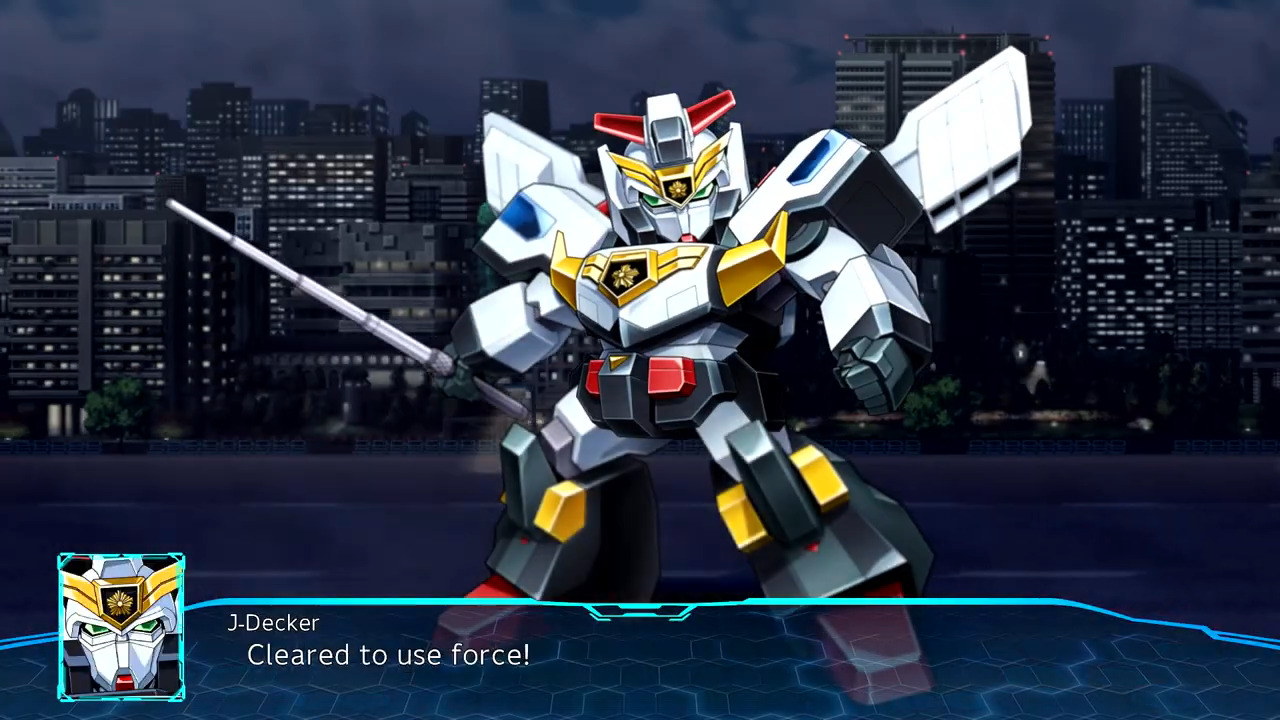
Takamatsu Shinji, director of Gundam X and J-Decker (Otakon 2015)

Park Romi (Edward Elric, Loran Cehack) press conference (Otakon 2015)

Seki Tomokazu, the voice of Domon Kasshu (Otakon 2013)

Teleport Them Chocolates: Ogiue Maniax Status Update for February 2021

We are on the other side of a terrifying four years, and I am glad to be here with you. Though we don’t know what the future holds, I feel somewhat optimistic.

However, we still have COVID-19 killing thousands of people a day, so I hope for the safety of you and everyone you hold dear. Also, I hope this is obvious, but please do not attend any anime conventions while we’re in the middle of a pandemic. Seriously, don’t. Stay home, and enjoy anime from the comfort of your TV or computer. The new anime season is in full swing, and Valentine’s Day is around the corner, which means plenty of talk about giri and honmei chocolates.

Thank you to the following Patreon sponsors for their support in the month of February:

General:

Ko Ransom

Diogo Prado

Alex

Dsy

Sue Hopkins fans:

Serxeid

Hato Kenjirou fans:

Elizabeth

Yajima Mirei fans:

Machi-Kurada

Blog highlights from January:

The “Blocker Corps IV Machine Blaster Crowdfund”: Help Preserve a 45-Year-Old Giant Robot Anime!

Mecha history is anime history, and I’d hate to see this show not get a proper digital preservation.

Chainsaw Man and Women in Refrigerators

A spoiler-heavy look at how one of the hottest current manga tackles a problematic old trope

Rookie Veteran, Veteran Rookie: The Gymnastics Samurai

How does this gymnastics-themed anime handle its “older” protagonist?

Hashikko Ensemble

Chapter 36 is the long-awaited debut of Jin’s mom! Spoilers: She probably got teen pregnant.

Closing

If you’ve got a favorite anime of the season so far, I’m all ears. I’ve been enjoying the return to form that is Show by Rock!! Stars! and the strange and irreverent Back Arrow.

Superdimensional Forte: Hashikko Ensemble, Chapter 36

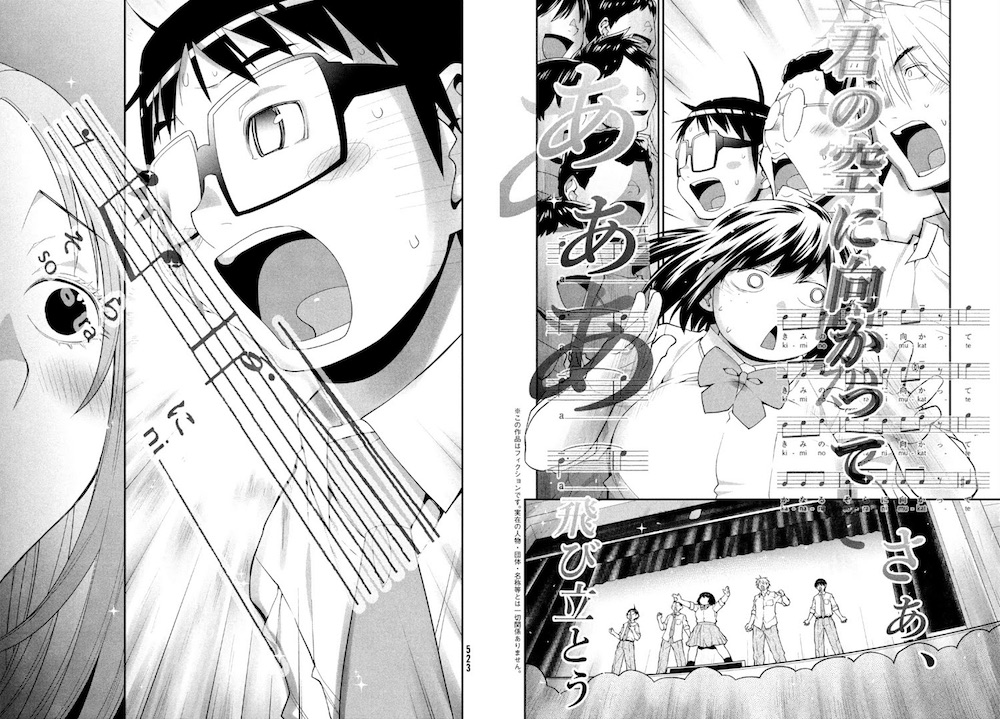
The Chorus Appreciation Society is performing "Do You Remember Love?" All the members are portrayed as standing apart, but also as if they're bing connected by the music.

Everyone gets hit by a Minmay Attack in Hashikko Ensemble, Chapter 36.

Summary

The next round is on, and the Chorus Appreciation Society takes the stage once again. Before that, though, Kozue asks Kousei why he doesn’t try to cheer Shion up after his rejection of her, and he replies that they’re just from different worlds: a safe rich girl vs. a delinquent with a lot of baggage.

This time, it’s “Do You Remember Love?” from the anime film Macross: Do You Remember Love. Akira and the others deliver a powerful performance that doesn’t just wow the audience, it seems to actually bond the members (and those close to them) together in a way that only music can. As they finish, Kousei seems to have Shion on his mind as he thinks, “Maybe our worlds aren’t so far apart after all.”

Elsewhere, Yumerun is pacing frantically, when finally the person she’s waiting for arrives: Jin’s mother, Kimura Reika, who turns out to be a highly eccentric 31-year-old soprano. The chapter ends as the two head out to Hashimoto Tech (Reika reluctantly so) in order to see Jin and the others sing.

Darkness and Light

Hashikko Ensemble is a series that’s high on levity, but the glimpses of darkness are astoundingly brutal. As Kousei is talking about his past, the first image shown is what appears to be a first-person perspective of one of his abusers (his mom’s lover, I think) rearing for a punch. This then transitions into Kousei throwing a punch at someone on the street in a fight. There’s a lot of trauma in his life, and the manga conveys a link between the violence inflicted on him and his rough attitude. 

Kousei is singing "Do You Remember Love" as Yukina suddenly sheds a tear.

That’s also what makes the portrayal of the society’s “Do You Remember Love?” all the more powerful. You can see in Kousei all this internalized fear, anger, and self-loathing, and it seems to just wash away as he sings. During the performance, Yukina (the arm wrestling champ who has a thing for Kousei) suddenly begins to cry during his performance, and she isn’t sure why. The way I see it, what she’s sensing is how strongly Kousei’s feelings are reaching out to Shion, and she’s realizing they’re not for her. Only in song is Kousei able to be honest.

I Love You So

I’m not well-versed in music, let alone the sheer breadth of what’s thus far been presented in Hashikko Ensemble. Many times, what this means is that outside of seeing the lyrics on the pages, I don’t always fully internalize what the songs are conveying in a chapter. This is not the case with “Do You Remember Love?”—it’s a song I know all too well, and it’s a staple of my karaoke sessions. In other words, I can really “feel” this chapter in ways that I haven’t been able to before. 

“Do You Remember Love?” is indeed a love song, but it’s also about reaching out to others and connecting. “I hear you calling out to me.” “I’m no longer alone, because you’re here.” Characters make mention of how well Akira and Kousei are harmonizing, as if they’re on the same page emotionally; most likely, it’s because they’re both singing to Shion. 

Questions are asked throughout the chorus of the song: “Do you remember when our eyes met?” “Do you remember when we held hands?” And while these lyrics are more romantic, their juxtaposition against Kousei’s traumatic memories makes me think that he’s actually, in a sense, remembering what it’s like to love The contrast between the beauty of the song and the violence of Kousei’s past is very fitting for a song played during the climactic battle of the Macross movie.

Jin’s Mom Is a Surprise

A comics page introducing Kimura Jin's mom, Reika. She definitely looks related to Jin, but is much more fierce in demeanor. She's complaining that it doesn't matter if she's late to see a bunch of amateurs singing, but also accidentally almost walks into glass because of her nearsightedness.

Kimura Reika is very different from what I pictured. When Jin described her in previous chapters, I was expecting an older strict woman—perhaps an unforgiving taskmaster with many years of experience and even a few wrinkles. In contrast, we get this weirdly aggressive and intense ball of energy who’s similar enough to Jin that you can see the familial relation, but also different to the point that you wouldn’t mistake the two. During her introduction, Yumerun asks why in the world Reika isn’t wearing her contacts, and she responds that she forgot them but also thinks it’s too much of a hassle to go back to retrieve them. When asked why she won’t just wear glasses, Reika claims that when she has them on, it makes her feel like her voice won’t fly out properly. That’s the sort of person Jin has to deal with in his home life.

And I have to point out the elephant in the room: Assuming that Reika is Jin’s biological mother, it also means she got teen pregnant! This isn’t the first time that the author, Kio Shimoku, has explored that topic (see his two-volume baby-raising manga Jigopuri), but I’m still surprised to see it pop up here. Just what kind of life has Reika gone through?

Songs

It’s noted that most of the groups only prepared one or two songs for the competition, so there are a number of repeats from previous chapters.

Basso Masters: “Daichi Kinshou” (Hymn of the Earth) from the cantata “Tsuchi no Uta” (Song of the Land)

Team “Promise” (a bunch of otaku): “Yakusoku” (Promise) from The iDOLM@STER

Yukio feat. Mayomyon: “Shibuya at 5 o’clock” by Suzuki Masuyuki and Kikuchi Momoko (You might recognize Suzuki as the singer of the opening to Kaguya-sama: Love Is War)

Noi Majo (Kurotaki Mai’s quartet): “Hakujitsu” (“White Day”) by King Gnu

Chorus Appreciation Society: “Do You Remember Love?”

You can find the above songs, along with previous references, in my Hashikko Ensemble Youtube playlist.

Final Thoughts

I’m really looking forward to seeing more of Jin’s mom. I feel like we’ve only scratched the surface of what she’s really like.

Mai’s group, Noi Majo, has moved on in the competition as well. I wonder if the groups will end up against each other. 

I named a previous chapter review “More Like ‘Protoculture Festival,’” and I wished I saved it for this one. Oh well.

The “Blocker Corps IV Machine Blaster” Crowdfund: Help Preserve a 45-Year-Old Giant Robot Anime!

Blocker Gundan IV Machine Blaster is a 1976 super robot anime that most people have probably never heard of. It doesn’t have a long and storied legacy, and its international presence is limited to the Philippines and Italy, where it was known as Striker Force and Astrorobot, respectively. But it’s also a part of the grand history of giant robots in Japanese animation, and now one of the studios that produced the show, Nippon Animation, has started a crowdfund project to convert the Machine Blaster film reels into a digital archive through the site readyfor.jp. The goal is 3 million yen, or approximately $29,000 USD, by February 26 Japan Time.

While Machine Blaster is in many ways a footnote of anime history, that’s all the more reason why I want to see it preserved. I think it’s easy to assume that the art and entertainment we as humans create will always be around in some form, but film wears down, or it can get lost and buried. For many years, the sole copy of the Korean giant robot animated movie Robot Taekwon V was a badly damaged reel, and it was only by luck that a near-complete duplicate film reel was discovered. Machine Blaster is no Gundam or Mazinger Z, but I love giant robots and I would hate to see even this obscure series not have a proper archived version beyond its DVD releases.

Also, while Machine Blaster is indeed not Gundam, it actually shares a mecha designer! Ookawara Kunio, the man responsible for the mobile suits of the original TV series (as well as shows like Reideen, Zambot 3, and Daitarn 3), is also behind the robots of Machine Blaster. He even has a written message on the crowdfunding page talking about his time with the series as one of the many 20-somethings there being thrown into a full-on project without much experience. 

If you’re like me and want to donate to saving Machine Blaster, I’ve provided a guide below, as the site is entirely in Japanese. Also, I should note that this is not a crowdfund to get a copy of the series; it’s just to help archive it. That being said, there are bonus goods for those who contribute more (though it’s not clear if they’ll send them abroad).

First, you’ll have to make an account on the site. At the top-right corner is a red button for logging in and creating an account. From there, you can either choose to register directly with readyfor.jp by clicking the red button on the right, or via Facebook using the button below it.

The blank spaces above, from top to bottom, are “user name,” “email address,” “password,” and “password again.” Then you’ll get a confirmation email, in which you’ll have to click a link to confirm your registration.

From there, if you go back to the Machine Blaster project, you’ll see another red button to the right of the main image. That’s the donate button, and it’ll take you to a page where you can choose how much you want to put in. Unlike other crowdfunding sites, you can only select along preset amounts, so the minimum is 3,000 yen, which gets you a thank-you message and updates via email. The most expensive one, seen below, is actually preview film reels of random episodes of Machine Blaster for 100,000 yen. The middle range has a bunch of merchandise you can get, like buttons and even a beach blanket. Choose which one you want, and note that you can actually select more than one at the same time. At the bottom, you’ll have the choice to pay via credit card or bank account. For payments outside of Japan, it’s probably better to use a credit card just because bank info in Japan can be very specific and have aspects that other countries don’t.

This is where it gets tricky. After putting in your credit card info, you’ll have to add your address as well. However, the form is not formatted for non-Japanese addresses, so you’ll have to work around it. Thankfully, if you just kind of fill it in as you would a normal address (and ignore the actual meanings of each form space, in case you can read Japanese), then it works out. Another crowdfund on readyfor.jp has provided a helpful screenshot, which I’ve also provided here. Note how the postal code in Japanese is just filled out as 111-1111. The only blank spaces this image isn’t showing are for your name.

From there, you hit the last button at the bottom and confirm your contribution! You can also write a message in the space provided.

Not every giant robot anime is going to be of legendary status, but I want to make sure we can keep and preserve as many as possible for both the fans who grew up with them and those who look back on anime’s history with curiosity. Blocker Corps IV Machine Blaster at least deserves that much.

PS: Like so many 70s giant robot anime, it got its own Italian theme song for the Italian dub. It is glorious, and worth comparing to the Japanese songs and their pleasant cheesiness.

There’s More to Life: Pixar’s Soul

Soul, the latest CG animated film from Disney and Pixar, speaks to me on a very deep and personal level. It’s not just that it’s about an older minority protagonist who chafes at family pressure when it comes to doing what’s safe and expected. Nor is it that the movie is set in New York City, where the familiar sights and sounds make me oddly nostalgic in a time when stepping foot outside can be a stressful decision in itself. What really hits home is one of the core messages of Soul, which is to be aware of how we as people often confuse inspiration, passion, purpose, and fulfillment—and how doing so can hold us back in life in fundamental ways.

The story of Soul follows Joe Gardner, a black middle-aged middle school music teacher who still dreams of being a professional jazz musician (the long overdue first black protagonist in a Pixar film). When a rare opportunity to play with one of the greats comes knocking, an ecstatic Joe gets caught in an accident that causes his soul to leave his body. Desperate to avoid the afterlife and get back to the land of the living (and his gig), he winds up as the mentor to 22, a soul that for thousands of years has failed to find the spark to become a full-fledged living being, and who sees her pre-life to be much more appealing than life on Earth.

Whether it’s Joe’s firm belief that his purpose in life is to play jazz, or the pre-life system that brings history’s greats in as mentors to guide those like 22 to begin life, Soul highlights the way people often think about what it means to live a great life. We celebrate those who follow their passion and transform them into monumental discoveries and achievements. We think having a greater purpose is the key to reaching greater heights. But just as Joe throughout the film is often so obsessed with his life-long aspiration that he fails to see the positive influence he gives (and receives) from those around him, it’s all too easy to feel like a failure when we focus only on destinations and not journeys.

Although I don’t see myself as being in a completely similar position to Joe, Soul made me realize something: for whatever reason, I often feel a lingering sense of guilt over not accomplishing more than I should have, or was supposed to. On a certain level, it can feel ridiculous. I’m at least fairly proud of the things I’ve managed to see and do in my life, achievements that I know took intelligence, dedication, and maybe even a bit of courage. Yet, I still see myself as rarely having ever gone the distance that can leave myself without any regrets. A career switch may have truly turned out for the better on a personal level, but still leaves me feeling that I left some potential unfulfilled. Even in the context of this blog here, I sometimes criticize myself for not having improved my writing as rapidly as I should have been, and for not having the drive to force that change upon myself. This guilt is in some ways internal and in other ways external, but the result is the same. 

Thanks to Soul, I realize now that I do indeed get caught up in conflating inspiration with passion, purpose with fulfillment, and so on. I haven’t resolved what exactly this means for me, or what it is that I ultimately will feel once I’ve sorted out these feelings and the degree to which I value them, but it has me on a long road of introspection. Not every film can do that, which makes having watched Soul all the more worthwhile.

Rookie Veteran, Veteran Rookie: The Gymnastics Samurai

The anime The Gymnastics Samurai is set in the year 2003, and nothing makes me feel older than having a fictional story ask “Remember back in the day?” about a time period that still in many ways feels like yesterday. But as the story of a veteran gymnast whose years are starting to catch up to him, it’s all too appropriate. The Gymnastics Samurai is not an altogether unique take on the trope of an old fighter trying to recapture glory, but it does stand out in a couple ways: its avoidance of faint and damning praise for its protagonist, and (for better or worse) the bizarreness of its setting details.

Protagonist Aragaki Jotaro, nicknamed “Samurai,” was once a former silver medalist in gymnastics who started a “Samurai boom” in Japan and around the world. Now, he finds himself a widowed father of one, unable to even approach his past success and considering retirement. However, a chance meeting with Leo, a foreigner dressed like a ninja, changes all that. Jotaro begins to wonder if there’s a chance he can keep doing what he loves, despite the fact that gymnastics is a young man’s game. In addition to the encouragement he gets from family and friends, he’s also egged on by a much younger rival who treats Jotaro as a dinosaur who should leave the spotlight for those with potential to fulfill.

The immediate comparison that came to mind watching The Gymnastics Samurai is 2006’s Rocky Balboa, the 6th movie in the Rocky franchise. In it, the famous Italian Stallion comes out of retirement for a boxing exhibition match against the current champion of the world, but has to re-invent his style once again (a recurring theme throughout the films) to make up for the fact that his body can’t move like it used to. Jotaro is in a similar position as Rocky, with a few key differences. First, Jotaro is nowhere near as old as Rocky in Rocky Balboa (29 vs. early 60s—almost a joke, in a way), and doesn’t have to deal with calcium deposits on his bones. Second, rather than Rocky’s approach of building muscle so that every punch he can land counts for more, Jotaro’s re-invention involves a return to fundamentals, and the muscle he does gain is to compensate for his old injury.

That second point is one of the most notable aspects of the story the anime is telling, because it’s in part a criticism of the notion that “spirit” and “hard work” can make up for anything. As the anime explains, Jotaro tried to work through his injury by just throwing himself further and further into gymnastics, only to end up aggravating his shoulder further. The fire of perseverance is not inherently a bad thing, but Jotaro has to learn how to work smarter instead of hoping to gain results from a mindless grind. Over-the-top training bordering on abuse is a classic (albeit dated) trope of sports anime and manga, so it stands out when a series like The Gymnastics Samurai puts it in stark relief with a more conscientious regimen.

There’s no doubt that it does get harder to keep up one’s physical peak as time passes, but the training Jotaro goes through is also not necessarily about abandoning what used to work for him. Instead, it’s a way to let him do what he was known for by providing a more stable structure. It reminds me of how Umehara Daigo, the most famous fighting game player in the world, trained to improve his reaction time rather than leaving it to his younger opponents because he didn’t want to limit himself by thinking like an old man (Daigo ended up winning a major online tournament). Note that Daigo is also older than Jotaro, being 39.

As for the bizarreness of The Gymnastics Samurai, although the anime is centered around a fairly straightforward sports narrative, there are a lot of little aspects of the show that seem like they come out of left field. Jotaro’s action movie-loving daughter, Rei, has a gigantic tropical bird (named Big Bird) who tells people to smile more. Leo appears to be a ninja-obsessed Japanophile whose use of theatrically archaic Japanese (de gozaru) is more a Japanese person’s idea of how a weeb would speak than any reflection of reality. Especially due to the bird, it reminds me of Tamako Market, which also has an avian creature providing comedy. These details make for a jarring tonal shift at times, which ultimately don’t remove the emotional impact of key moments in The Gymnastic Samurai but can still leave a sense of bewilderment.

The Gymnastics Samurai is one of the latest instances of a story that asks whether an old dog can indeed learn new tricks. While it’s not entirely a criticism of ageism due to its hero still being a reasonably spry 29, the series does give credence to the notion that re-invention and restoration are possible, especially where passion meets wisdom. In a genre of anime and manga dominated by stories about high school athletics—and where graduating at 18 is seen as the first step into mythology—Jotaro gives at least some hope to those who still want to compete.