[AnimeNEXT 2017] TMS/Re:Life Interview

At AnimeNext 2017 back in June, I got to speak to the staff of the anime Re:Life. It was a short but informative interview that also went into other shows they’ve worked on, including an anime from the same studio as Kemono Friends.

Re:Life is about a man who gets the chance to relive his high school days. When creating and animating the show, is there anything you had to consider in terms of body language, such as how an older man would act or move that a younger man would not?

Yamanaka Junko: So in terms of body language, by the time you’re 17 you’re pretty much grown as a male. So in terms of the body itself, nothing really changes between 17 and 27. If anything, it’s more the voice actors and actresses who have to portray the 10 years of change, of mental instability.

My next question is for Ueda-san. You worked on a very humorous anime called Tesagure! Bukatsumono. What was it like? It seems like a very unique and interesting experience.

Ueda Reina: Pertaining to this particular series, what we would do is record three minutes of airtime for one hour. There was no dialogue written out. The beginning and ending were set but everything in the middle was all ad-lib. So for the next fifteen minutes, we would do three-minute segments of ad-libbing the entire time, and then we would take multiple episodes in one day. During the set, the actual recording process, there was so much laughing because everyone was laughing at each other’s ad-libbing. It was really fun to work on.

Yamanaka-san, you’ve worked on Detective Conan for many years, on multiple movies and the TV series. When working on the series, are there any golden rules that you must adhere to, like things you must do to make it feel like Conan?

Yamanaka: Someone has to die (ha ha).

The dart hitting Kogoro is an iconic moment.

Because it’s a story about detectives, the actual solving part is where we spend the most energy.

Because Re:Life is about NEETS and redoing your past, do you think this is a more universal or timeless theme, or is it specifically relevant to modern times?

Yamanaka: This is a very difficult question because it’s hard to assume things, but the perspective of the NEET has been around for a while, and the creation of the word is further back. Maybe it’ll still be timeless, but it’d be better for Japan if this is not timeless, and no one remembers what a NEET is anymore.

Thank you for the interview!

Planetary Remix: Eureka Seven Hi-Evolution 1

This review is part of Ogiue Maniax’s coverage for Otakon 2017.

To this day, Eureka Seven is one of my favorite anime ever. From the pacing to the characters to the messages conveyed, it is a joy to watch and to think about. Over the years, Eureka Seven has returned in many different forms, from an unusual experiment in “re-casting” its characters, to a flawed sequel. At Otakon 2017, I got the chance to see the world premiere of Eureka Seven Hi-Evolution 1, the first of a new trilogy of movies, I had to wonder just what form it would take. The result is something I certainly did not expect.

The general story of Eureka Seven is the science fictional romance of Renton Thurston, a teenage boy from a nowhere town, and the titular Eureka, a teenage girl who is actually of a mysterious other species known as “Coralians,” and one of the few to take human form. A world filled with giant robots, music, and youth culture, the original anime exuded a sense of style and sincerity that few works manage to capture.

Hi-Evoluton 1 actually starts off as a prequel to the events of the TV series, portraying the “Summer of Love,” the mysterious event where Adroc Thurston—Renton’s father—saved the world and became a hero. The second is a Throughout the original television series, it’s hinted that the events of the Summer of Love didn’t quite go as officially reported, so it gives insight as to just what caused the conflict. For this first half hour of the film, all of the animation is new, and we get to see a number of characters who would come to play pivotal roles in the main series, including Eureka herself.

The second part of the film is where things get unusual.

It’s common for movie series based on popular franchises to front load its films with existing footage and familiar scenes, such that the first film is a time saver, a money saver, and a way to catch unfamiliar viewers up with what a work is all about. Mobile Suit Gundam did this, Space Battleship Yamato did this, and most recently it’s been the hallmark of the Rebuild of Evangelion movies. Most of the time, these Part 1’s tend to be straightforward, acting as quick compilations/retreads that change little from the original material but set up the possibility for future deviations.

Not so with Hi-Evolution 1. While it certainly would have been possible to just cut and splice the TV series into a large recap movie, the film instead decides to focus on a particular crucial arc of Eureka Seven. When Renton leaves the Gekko (the ship of anti-government rebels of which Eureka is a part), he ends up living with a couple named Ray and Charles Beams, and in doing so matures tremendously within a short span. In the original TV series, this doesn’t happen until about 13 episodes in, so the fact that the movie cuts out such a large chunk of the early episodes is unorthodox in itself.

Combined with this, however, is the fact that the film then decides to play with time. Instead of presenting its events chronologically, Hi-Evoluton 1 sees fits to go back and forth in time constantly, marked by black and white transitions of “Play Back” and “Play Forward.” It can be jarring, and much of the audience’s audible reactions showed a desire for the film to just dispense with the jumping around. For me, I kept wondering why the director, Kyoda Tomoki, decided to do things this way when a standard compilation approach would have theoretically been much easier.

I have three thoughts. First, focusing on Renton’s time with Ray and Charles over the beginnings of his relationship with Eureka juxtaposes him with Adroc’s portrayal from the beginning of the film. Second, the order in which the scenes play out is not chronological but rather an “emotional order.” Third, the creators of Eureka Seven seem to see their works not as ways to return to the world of their creation, but as a way to “remix” them.

Renton is shown to be quite similar to his father in the sense that both have strong convictions do what they feel is right even if it means everyone’s against them. The crucial difference, which gradually narrows over the course of the film, is maturity. Adroc risks himself to save Eureka, but it comes from a kind of wisened, fatherly position, as well as that of someone who understands the consequences of going against the world. Renton, impetuous youth that he is, initially doesn’t quite fully comprehend the tough decisions. By manipulating the progress of time, Hi-Evolution 1 seems to want to first juxtapose the turbulent emotions of teenage Renton and then gradually draw them closer to Adroc’s convictions. I find it notable that Adroc is voiced by Furuya Tohru, famously the voice of main hero Amuro Ray in the original Mobile Suit Gundam. Not only is there a kind of parity in terms of movie compilation trilogies, but it makes thematic sense that Renton is the “descendant” of Amuro.

Music is a major part of Eureka Seven. Characters’ names, robots, ships, supernatural phenomenon, almost everything is a reference to music (the most obvious one is probably “Ray” and “Charles”). There’s a lot about rhythm and musicality in the series, and it gives me the impression that the creators treat it as a kind of “song.” The full English title is Psalm of Planets, Eureka Seven, after all. The previous film, Pocketful of Rainbows, was an experiment in seeing how different a story they could tell by using existing footage. In it, Renton and Eureka’s circumstances are far different, and even their personalities don’t quite match up with what fans were familiar with. In other words, it felt like a heavy remix of a familiar song, one in which the original tune is almost unrecognizable.

Hi-Evolution 1 feels like a remix that tries to retain more of the source than Pocketful of Rainbows, but still desires to be its own thing. It has the same characters and general story as the TV series, but with a few touches that emphasize different elements more. In particular, the relative lack of Eureka in the film is rather conspicuous, as is the complete absence of Eureka’s “rival,” Anemone. At the very least, we know the answer to the latter, The film concludes with a “next movie preview” showing her that is rather surprising to say, the least. I’m going to leave this exact spoiler ambiguous, but I will say that it looks like Hi-Evolution 2 is going to be deviating more heavily from the TV series, just like Evangelion 2.0.

After the film, Kyoda did a moderated Q&A. In it, he revealed the staff’s code names for the first two films. Hi-Evolution 1 is “Renton 7.” Hi-Evolution 2 is “Anemone 7.” If we think of these films as highlighting and drawing out different essences present in the TV series and creating new melodies from them, the general direction of this trilogy starts to make more sense.

Ash Ketchum and the Case of Filler Arc Character Growth

Ash Ketchum (Satoshi in Japan) is an ageless character. Whether it’s 1998 or 2017, Ash will always be 10 years old, will always be traveling with Pikachu, and will always be just not quite good enough to win a major championship. When he’s fighting through Kanto or Kalos, he won’t dominate the competition with his massively powerful Pikachu, and he’s perpetually more of a learner than a master in spite of his experience. It makes sense, because that’s how his character’s supposed to be. When he points his Pokedex at the same Pokemon for the 10th time in 10 years, it’s not because he’s supposed to be dumb but rather for the sake of a young audience who might be watching Pokemon for the first time.

Ash doesn’t always act as the impetuous rookie, and at times he’s allowed to shine as the battle-hardened veteran. Curiously, however, these mainly come when the Pokemon anime is not trying to go through its main narrative. During the filler arc that was the Orange Islands (taking place between the first and second generations of games), Ash was allowed to have a 6 on 6 battle and even defeat the Orange Islands champion. When Ash was participating in the Battle Frontier, post-game content within the context of the games, he would call upon his entire previous roster. The opening video during that arc reflected the full range of Ash’s experience by showing every Pokemon at his disposal (and even cameos by ones since released such as Butterfree). Ash eventually won the Battle Frontier, again showing how strong he was, but only within the between-games storylines.

Perhaps the biggest exception to this rule was when Ash finally got to face Gary in a full on 6-on-6 battle in the Johto League finals. The context behind this was that Gary’s Japanese actor was taking on less of a role in the series so they wanted him to go out with a bang and they succeeded. Just like his eventual Battle Frontier victory, Ash was allowed to show just how much he had learned over the years, at least for one climactic confrontation. It reminds me of how the Archie Sonic the Hedgehog comics kept running even during the years-long lull of no new Sonic games, and it was during those times that they dared to go as far as killing Dr. Robotnik. To a lesser extent, it makes me think of how during the infamous Naruto year-long filler arc, characters such as Hinata were allowed to get new techniques and grow more powerful.

I find Ash’s situation this interesting because it reflects both the realities of making an anime based on an wildly popular game and a desire to provide continuity or growth when the opportunity arises. Ash has to be eternally youthful, yet his viewers grow up and remember all of his adventures. The anime’s creators likely also have to mindful of the source material, especially as the series has grown to such international success (the earliest seasons played rather fast and loose with the rules).

What do you think of this balance? Do you wish Ash could be 20 years old by now, training atop a mountain like Red in Pokemon Gold, Silver, & Crystal?

A New Way to Look at Precure Character Archetypes

The Precure Pretty Store in Tokyo has a new batch of idol-style merchandise around the theme of “summer festival.” For it, each of the girls are wearing special outfits and have been separated into different groups around a common theme.

While that’s not unusual in itself, what I find fascinating is that the groups for the most part are not along traditional lines, like “show origin” or “color.” In fact, there doesn’t seem to be any real consistency from one theme to the next. Even so, I think it provides a new perspective on shared values between individual characters, so I’ve decided to lay out the categories below.

Pro Celebrities: Kasugano Urara, Amanogawa Kirara

Love: Momozono Love, Aino Megumi, Aida Mana

Otherworld Singers: Kenzaki Makoto, Kurokawa Eren

Fantastic Dreamers: Haruno Haruka, Yumehara Nozomi, Asahina Mirai

Athletes: Misumi Nagisa, Hyuuga Saki, Natsuki Rin, Hino Akane, Midorikawa Nao

Wildly Expressive: Kurumi Erika, Shirayuki Hime

Bookish Glasses Girls: Yukishiro Honoka, Hanasaki Tsubomi, Tsukikage Yuri, Shirabe Ako

Fairies-turned-Precure: Hanami Kotoha, Mimino Kurumi

Creators: Mishou Mai, Akimoto Komachi, Hoshizora Miyuki, Kise Yayoi

Martial Artists: Myoudouin Itsuki, Aoki Reika, Yotsuba Alice, Hikawa Iona

Musicians: Minazuki Karen, Houjou Hibiki

Secret Hard Workers: Aono Miki, Izayoi Liko

Chefs: Kujou Hikari, Minamimo Kaede, Madoka Aguri, Oomori Yuko, Usami Ichika

Aspiring Doctors: Yamabuki Inori, Hishikawa Rikka, Kaidou Minami

White-Haired (Former) Villains: Eas (Higashi Setsuna), Twilight (Akagi Towa)

Princes: Coco, Natts, Masame Oji, Kanata

Villains Disguised as Schoolboys: Kiriya, Luntaro (Wolflun), Kurosu (Close), Rio (Julio)

Young Mascot Fairy Boys: Syrup, Pop, Rakeru, Rance, Aroma

(The One Exception) Kira Kira Precure a la Mode: Kenjou Akira, Tategami Aoi, Kirahoshi Ciel, Usami Ichika, Arisugawa Himari, Kotozume Yukari

So what do you think of these categories? Do you like thinking of Precures along these lines? The one category that still perplexes me a bit is “Secret Hard Workers,” because Liko and Miki have very little in common. Is there something else they have in common that I’m missing?

And where would the a la Mode girls fit if they had to be divided into them? Would they all go into “chefs,” or would that only work for some of them? For example, would Aoi fit better in “Musicians?”

Save

Save

Save

[APT 507] How the Precure Age Experiment Set the Stage for Yuri in Kira Kira Precure a la Mode

Yuri fans have long been into Precure, but a recent episode of the newest series placed yuri front and center into a world that normally shies away from such a direct presentation. See my thoughts on how character age has paved the way for yuri in Precure at Apartment 507.

Hell Hath No Fury: Benten in The Eccentric Family 2

The Eccentric Family (Uchouten Kazoku) is an anime series of many strengths. Utilizing Japanese mythology to tell a humble yet sprawling tale of family and community, its characters all stand out in different and interesting ways. Of the cast, arguably the most compelling is Benten, a human woman with the powers of a tengu, a divine creature with control of the wind. The original series establishes her as beautiful, powerful, and able to string characters along with the greatest of ease; in a way, she’s a little too perfect, which is why I’m especially impressed that the sequel, The Eccentric Family 2, devotes itself to showing an heretofore unknown side of Benten: when things don’t go her way.

Benten’s teacher is Akadama, an old tengu with injured wings who is incredibly smitten with Benten—something she uses to her full advantage. The Eccentric Family 2 introduces a character called Nidaime (“The Second”), the estranged son of Akadama. As the fallen successor, Nidaime is an incredibly powerful tengu in his own right, and proves it by actually besting Benten in combat. It’s clear how this impacts Benten, who up to this point has been unchallenged. To make a comparison to Dragon Ball Z, Benten is like Freeza: someone who could fight more or less unopposed and thus when it came time to push herself was unaccustomed to doing so. Upon her first defeat, we see Benten training. Even going so far as to visit Hell and wrestle oni.

When Benten and Nidaime finally have their rematch, they’re far more evenly matched, but another of Benten’s strengths, her beauty, is ultimately her downfall. During the fight, Nidaime sets Benten’s hair on fire, and for the very first time in all of The Eccentric Family, she is emotionally compromised. Her scream of horror as she realizes what’s happened to her is so unexpected that, at first, it seems like she’s just playing both the audience and the characters, like she always does. Then, as she falls into the water, it becomes clear that this is no act.

Moreover, Nidaime’s attack highlights another aspect of Benten’s character: how aware she is of her own attractiveness, and the extent to which she actively cultivates it. She clearly knows that her hair, as part of her overall appearance but also as a symbol of erotic feminine beauty, contributes to her aura. It’s what allows her to manipulate everyone, from lowly tanuki to humans to tengu. Losing her hair is akin to losing a significant part of her power and influence.

Benten, in this Ivan Drago-esque position of becoming self-aware of her own mortality, becomes similarly sympathetic to the Soviet boxing champion. She was already a fascinating character, but now you can see the subtle cracks in her armor. Benten doesn’t seem like the type to change significantly or to turn a new leaf, but she goes from being the pinnacle of perfection to someone who perseveres in trying to maintain that infallibility.

Save

Save

The Lightness of Light Novels and the Magnified Hate of Light Novel Anime

Today’s anime industry is filled with light novel adaptations, many of which revolve around tropes that are loved by some and hated by others. Common ones include ridiculously long and descriptive titles, an average passive guy who discovers a special power, and the throngs of girls (some of whom may or may not be his little sister) who fall for him as he saves the world. For those who aren’t fans, the term “light novel anime” has come to be filled with a certain level of apprehension. “Oh, it’s a light novel anime, but don’t hold that against it.” However, while the contents of these stories contribute a large part in why they draw ire from some anime fans, what I think is an equally important factor is the implication that a good deal of money is required to adapt a light novel into an anime.

Generally speaking, the “light” in light novel refers to the fact that they’re supposed to be light reads. Sure, they might be full of esoteric jargon (hello Index) and long and complicated word play (Monogatari), but for the most part light novels are meant to be easy to pick up, finish, and put down. It doesn’t cost much to write a light novel, relatively speaking: it’s usually one person writing, and one person doing a handful of illustrations. Overall, while the industry itself isn’t necessarily cheap, the act of writing requires only a pen and paper (or keyboard and computer).

Imagine you’re presented with a book that’s full of the same tired elements, and even reeks of some author’s self-insert revenge fantasy. Its prose seems stiff and workman-like, without any creative flair. You read it, make a face, and then put it away. No harm, no foul, and even though you might later find out it’s popular and don’t personally understand why, this simple “light” book is no skin off your back.

However, then you find out that the book is being made into a Hollywood movie. They’re pouring millions of dollars into it. It feels weird, almost as if it weren’t meant to stand on this grand of a stage.

This, I think, is akin to what happens sometimes when a light novel gets adapted into an anime. Of course, there is much, much less money in the anime industry compare to big budget films, but there’s still a transition from a light novel, a piece of fiction similar in function to old American pulp magazines, to something that requires funds, hiring of talent in great numbers, and just a great deal of combined energy. As Shirobako has shown, anime production is a grueling process, and the idea that the anime industry is putting all of that energy into making some bad light novel look good can seem to detractors like a waste of finite resources.

The industry standard for the “look” of anime involves a certain higher level of polish and presentation. Most shows on a very basic level pass the test of “does this look like it was drawn and created by professionals?” What this means, then, is that whether an anime is based on some award-winning novel or something else entirely, they have similar levels of professionalism. The amateurish qualities of a light novel, which might have been forgivable for more people if they remained in that realm, vanish, and this causes fans to look at these stories from a different perspective.

In other words, if all light novel anime looked like gdgd Fairies or Ai Mai Mii, I don’t think they would get quite as much hate. Actually, that’s something I would love to see.

Sound the Gong: Ogiue Maniax Status Update for August 2017

Otakon is this month! With guests like the director of Eureka Seven, JAM Project, and more, I’m unbelievably hype for this year’s convention. If you happen to spot me at the con, feel free to say hello.

Thanks to all of my Patreon sponsors!

General:

Johnny Trovato

Ko Ransom

Alex

Diogo Prado

Viga

Yoshitake Rika fans:

Elliot Page

Hato Kenjirou fans:

Elizabeth

Yajima Mirei fans:

Machi-Kurada

I want to talk about Twitter for a bit. In the past, I’ve never really had any of my tweets go wild; the most successful one I had for the longest time was this:

That was almost two years ago. But all through July, I’ve been hitting it out of the park in ways I hardly expected. I was never good at the social media game, so seeing my tweets go viral again and again is hard for me to wrap my head around.

Have I figured something out? Only the future knows…

Anyway, here are monthly post highlights:


Gattai Girls 6: The Super Dimension Cavalry Southern Cross and Jeanne Fránçaix


After three long years, it’s finally the 6th entry in Gattai Girls review series! I look at mecha anime starring female robot pilots.

Pre-Evo Thoughts: Video Games vs. Chess Analogies


Gamers love to say that their favorite game is comparable to chess. But couldn’t we think through the analogy more?

Bootleg Products and the Defiance of Value


Bootleg stuff is often either demonized or written off as harmless, but what effects does it have on a fandom’s ability to grow itself?

Patreon-Sponsored

Aikatsu and the Power of Not Running Jokes into the Ground
The Aikatsu !posts continue! This month, I look at how great the humor is in this series. You might think I’m being paid by the creators or something, but it’s just that my biggest patron is a huge Aikatsu! fan!

Return to Genshiken

Return to Genshiken: Volume 4 – Ogiue Descends

Ogiue’s finally here! Starting this volume, I’ll be using the Japanese books along with the English ones for my re-reads.

Closing

Hopefully the next Gattai Girls post won’t take nearly as long. I’m waffling between… Patlabor and BBK/BRNK. What do you think?

Anyway, see you at Otakon!

Save

Save

Save

[AnimeNEXT 2017] Studio Trigger Interview

Last time, I asked the illustrious Studio Trigger about the origins of Turning Girls. This time I only had the chance for one question to Yoshinari Yoh (director of Little Witch Academia), but the answer was quite informative.

When you were a lowly footman in the anime industry, what did you swear you’d do when you got further? Like, “If I ever become director, I will definitely do this.”

Yoshinari Yoh: When I just entered Gainax, it was right when Sailor Moon was airing, and I was reading an article in a magazine. I remember commenting, “I would never want to do something about magical girls.” But then once I entered Gainax, the executives (such as Anno) loved Sailor Moon, so I ended up working on it.

Thank you for the interview!

Return to Genshiken: Volume 4 – Ogiue Descends


It’s finally here—the advent of Our Lady of Surly Shipping, the Angriest of Fujoshi, Ogiue Chika. To call this a major event in the series would be an understatement, but I’m getting ahead of myself.

What is Return to Genshiken?

Genshiken is an influential manga about otaku, as well as my favorite manga ever and the inspiration for this blog, but it’s been many years since I’ve read the series. I intend to re-read Genshiken with the benefit of hindsight and see how much, if at all, my thoughts on the manga have changed.

Note that, unlike my chapter reviews for the second series, Genshiken Nidaime, I’m going to be looking at this volume by volume. Starting with this volume, I’ll be using both English and Japanese versions of Genshiken! Also, I will be spoiling the entirety of Genshiken, both the first series and the sequel, so be warned.

Volume 4 Summary

Due to the fire accidentally started by Kasukabe, the Society for the Study of Modern Visual Culture has been temporarily suspended, with club room privileges revoked and its members assigned mandatory community service. Feeling incredibly guilty over causing all of this trouble, Kasukabe reluctantly volunteers to go to Comic Festival to buy doujinshi for the others and even participate in a cosplay contest. There, she not only punches out a guy trying to get some upskirt shots, but her striking appearance causes the embers in Madarame’s heart to ignite into a flame.

More revelations and events follow. Tanaka and Ohno have started dating. Madarame passes on the mantle of club president to Sasahara, who declares his intent for Genshiken to create a doujinshi to sell at ComiFes. The club even gains two new members: Kuchiki, a familiar face who was rejected from the Anime Society, and Ogiue, a standoffish otaku-hating girl who literally jumped out a second-story window to spite the other Manga Society girls. So Genshiken grows with two problematic additions.

Saki’s Remorse
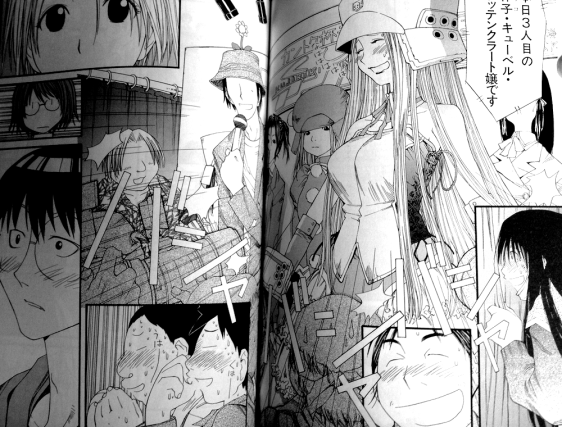
The way Saki’s guilt slowly eats at her, culminating in that single tear rolling down her cheek, is quite subtle. Her stoic expression as they move from one member’s apartment to the next in lieu of a club room is easy to miss. Even more significant is why she feels so bad about the situation.

It’s not simply a matter of being responsible for the fire, it’s that she sees how lifeless the others have become. It’s as if her actions have robbed them of the very space where they can open up and just enjoy being who they really are. This is where I think Saki truly becomes one of them—even if she’ll never be an otaku, she at the very least can empathize with their energy.

Later in Nidaime, when Madarame finally confesses to Saki, his thoughts go back to this moment: “I always knew that Kasukabe-san cries easily.” It was her first true moment of vulnerability in the series, and may be what planted the seeds of “Kasukabe is moe” in his head.

The Ritsuko Kubel Kettengrad cosplay she does in this volume is, in some ways, merely the icing on the cake. But what an icing it is!

The Cosplay Heard ‘Round the World

Saki’s cosplay is the catalyst for many future threads in Genshiken. It’s the moment Madarame confirms his own feelings for her. It’s what prompts him to get those photos of her, which eventually are found by Hato. It’s what leads to Saki pressuring Ogiue to cosplay as Renko from Kujibiki Unbalance.

Speaking of those Saki photos, I’ve always been fascinated by how they’re made to look more…lustrous…than the actual characters themselves, including Saki. It gives those pictures a kind of aura, almost like this is how Madarame sees her. Comparing the photos to the actual depiction of Saki, the difference is that the photos use screentone shading for her outfit, and that she looks comfortable and poised in them (as opposed to nervously sweating like in the image earlier).

There’s actually another moment related to this cosplay that I think marks the beginning of something special, which is a clear sign that Kio Shimoku is paying more and more attention to page composition.

In the above scene, we see from Kasukabe’s point of view as she tries out her Ritsuko cosplay for Ohno. For each panel, Ohno is in a similar position on the page, creating a clear vertical column that unites the page from top to bottom. At the same time, the fact that Ohno’s size varies relative to each panel gives it some variety and keeps it from feeling repetitive. It’s simple yet highly effective, and captures well the concept of “flow” in manga.

Tanaka: Best Friend and Boyfriend

Model kit and cosplay-loving Tanaka ultimately gets fewer dedicated chapters than many of the other characters in Genshiken. It’s sort of a shame, as the brief spotlights he gets here (though shared), point towards an interesting fellow. Not only do we get the sense that he and Ohno have been developing their feelings not-so-under the surface all along, but let’s not forget that he was the first of the “total dork” otaku to get a girl. As the characters themselves mention, it only makes sense. It’s not just that their hobbies overlap, but that their respective passions for their hobbies run equally strong.

The anime Genshiken 2 actually saw it fit to devote an episode to exploring the sexual side of Tanaka and Ohno’s relationship. In the manga, we only get Ohno’s lament that he still hasn’t made a move, and then towards the end of Nidaime we find out that he gets to see Ohno “only” once a week. Talk about progress!

Tanaka’s connection with Ohno is not the only highlight here. When most of the club finds out about them dating, it turns out Kugayama knew already because Tanaka told him. Here, you get the idea that they’re really close friends, arguably closer than any other two characters in a platonic relationship in the entire manga. By being a little more in the background, I get the sense that they’re having these private conversations on the regular, and we the readers are only privy to the crumbs.

Sasahara’s Ambition

The reason behind Madarame giving Sasahara the presidency is the interesting one. Essentially, he says that Sasahara is the one most true to being an otaku. From the perspective of 2017, this brings to mind the notion of “real geeks” vs. “fake geeks,” but it’s worth noting that Sasahara is the most inexperienced otaku out of all potential prospects (and Saki doesn’t count by not having a single otaku bone in her body). Ohno is well-known cosplayer with years of experience, and Kousaka is basically Madarame-level, but the big difference is that both Ohno and Kousaka are able to fully function in the world of non-otaku. Part of it is simply due to looks, but there’s a sense that what lies at the core of Genshiken as a club is personal and social dysfunction. If you’re able to function and thrive that easily among “normal folks,” can you be true to the spirit of the classic otaku?

The assumption that otaku will always be society’s rejects is also very telling in hindsight. After all, the whole Densha Otoko boom was about a year or two away at this point in Japan, and eventually Ohno does become president after Sasahara. The image of otaku begins to transform from those whose passions prevent them from being able to succeed to those whose passions help them succeed. It’s why Yajima in Nidaime is so self-conscious about her role in Genshiken—everyone else is attractive and/or successful, and Yajima is, in her own mind, fat and ugly and untalented.

But perhaps Sasahara is himself emblematic of this change. As soon as he becomes president, he declares his desire to create a doujinshi for Comic Festival, something that the club has basically avoided because none of them have the drive or the active desire to put in the hard work. After all, they did reuse their club presentation materials so much that the paper has started to brown. They’re slowly going from a do-nothing club to a do-something club, and a certain paintbrush-haired fujoshi eventually becomes central to that.

Ogiue Time

I had almost forgotten that, when we first meet Ogiue, we don’t quite know that she’s a closet fujoshi yet. We know she’s an otaku who hates other otaku for whatever reason, but it’s not until the next chapter that we see her get tempted by the Genshiken honeypot pile. She just comes across as an incredibly troublesome character with very brief glimpses of vulnerability, especially when Saki comforts her after Kuchiki puts a hand on Ogiue.

Because Ogiue is introduced alongside Kuchiki’s re-introduction, they’re presented as contrasts. Ogiue, coming from the Manga Society, is reticent, grumpy, and unwilling to open up to others. Kuchiki, coming from the Anime Society, is loud, spastic, and a little too lacking in a filter. Perhaps I’m biased, but I can see why Ogiue got more of the spotlight as the series goes on.

I think there’s a bit lost in Ogiue’s introduction in English versus the original Japanese. “My name is Ogiue, and I hate otaku” is a perfectly good translation, and it’s how I’d translate it as well. It sounds good in English, and it’s how English speakers typically introduce themselves: I’m [name] and I [do/like/am something]. But in Japanese, she says, “Otaku ga kirai na Ogiue desu“—”I am the otaku-hating Ogiue.” The very first thing she blurts out is her dislike of otaku and, as we later learn, her self-loathing. Maybe something like “I hate otaku. Hi, I’m Ogiue” would work better?

It’s also notable that Ogiue’s design is somewhat different at this point. Her side hair antennae are a little more angled, and her face is sharper. The character designs as a whole get a bit rounder over the course of the manga in general, but this specific version of Ogiue really gives off a “dangerous, do not touch” vibe.

Another thing to point out is how, while Ogiue’s eyes change permanently after she starts to date Sasahara, you see glimmers of it in Saki’s interactions with Ogiue right from the beginning. Saki’s quite good at breaking down walls, after all.

Final Random Thoughts

I need to make a correction to something I said back in Volume 2, which is that the original president never shows up again. But he does, right here in Volume 4! He dispenses some advice for Saki, that flits off to wherever wizened old otaku leaders go.

Last thing: One of the club discussions that crops up in this volume is comparing the Kujibiki Unbalance manga to the anime, where the former is inevitably considered better than the latter by its members. The anime is noted as having many more jokes, and overall being a crazier experience. What’s funny to me about this comparison is that it’s clear the Kujibiki Unbalance OVAs we got with the first Genshiken anime are trying to be the anime spoken of in this volume. It’s a bit of meta-humor for Genshiken fans, and it won’t even be the last time this sort of referencing occurs.

Save

Save

Save

Save

Save

Save

Save

Save

Save

Save

Save

Save

Save