Sephiroth has been announced as the latest DLC guest character in Super Smash Bros. Ultimate to great fanfare. I certainly didn’t expect him because I figured they would want to spread their 3rd party characters among as many companies and franchises as possible for the widest marketing reach—let alone having a second Final Fantasy VII character, even if there is a big remake currently. Why Sephiroth?
The answer, I surmise, is that he fulfills an ongoing theme of having villains to contrast some of the biggest heroes in Ultimate. This is the game that added Ridley and King K. Rool to the roster, and K. Rool’s trailer even emphasizes the different rival pairings that exist in Smash. There’s a special place for the One-Winged Angel in the pantheon of video game villains, and he more than deserves a place among the other all-stars in Smash. Sephiroth is the first third-party villain in the game, and the first villain DLC.
But Sephiroth’s appearance makes me realize something: much to my chagrin, it’s highly unlikely that any antagonist or boss can get into Smash as a playable character without there first being a protagonist to contrast them. I would wager that, in another universe where Cloud had not managed to debut in Super Smash Bros. for 3DS & Wii U, he would have been the one to appear now instead of Sephiroth. It’s understandable why they would go for heroes before villains, given that the bad guys are usually not the most prominent mascots of their video games, and the good guys are usually the player characters. Even a generic hero like, well, Hero, takes precedence over Zoma or Dragonlord from the Dragon Quest series.
There is a game that has leaned more toward villainy when it comes to its guest characters, though. Tekken 7 has Geese Howard but not Terry Bogard, Akuma but not Ryu, and Neegan but not whoever the protagonist of The Walking Dead is. That’s a very different sort of environment, of course, given that Tekken is a standalone world and not inherently a crossover like Smash is. Again, I see why Smash would not want standalone bosses to take up too much of the roster, but I’ve just always thought it would be a nice way to add some diversity without taking up two slots instead of one.
Of course, nothing is ever set in stone with Smash in terms of how or why new characters are chosen, but I think “villains second” just makes sense, even if I wish it didn’t. The only possible exception I could see is if said antagonist all but defines a certain video game’s identity. Which is to say, maybe Carmen Sandiego still has a shot…?
In any case, I’m looking forward to the Sephiroth gameplay reveal.
Anime about game-like worlds have something of a stale reputation these days. The sheer ubiquity of virtual reality and RPG-inspired isekai anime results in many series taking relatively shallow treatments of their science fictional aspects. Obsession with game mechanics and/or power fantasy are par for the course. Amidst these trends, Deca-Dence is not only refreshing for its interesting worldbuilding and compelling characters, but it also feels like a genuinely innovative look as well as subversion of game-derived concepts within the context of a society built around them.
Deca-Dence is a tricky anime to review due to its many plot twists. It’s not the type of series that is “ruined” by knowing the big spoilers, as full knowledge of what’s really going on just invites more questions to ponder over, but I think it’s more knowing less so that the show can work its initial magic.
Thus, the most I’ll say about the basic premise is this: Deca-Dence takes place in a world where humanity is confined to a mobile fortress called the Deca-Dence, which is key to their survival against mysterious monsters called the Gadol. Assisting them in their fight is a system reminiscent of the vertical maneuvering gear of Attack on Titan: backpacks that allow people to levitate, and harpoons capable of draining a vital fluid from them that can be used as a power source. The story focuses on a girl named Natsume, who loses both her father and her arm in humanity’s battle against the Gadol, and it’s the clash between her desire to become a front-line fighter and her self-perception as a relative nobody that gradually opens up the secrets of the world to her. Of all the people she gets to know, the most important is a man named Kaburagi, a former combatant who’s tired of living.
The term I use to describe Natsume and many of the other characters is “NPCs,” or non-player characters. I understand that the term might raise some eyebrows, as it’s commonly used by the alt-right to demean and diminish those who don’t follow their hate-filled ideologies, but here it’s meant in the context of characters who “matter less” within their world because they’re not supposed to be the ones going out and achieving glory. There’s a very clear divide in their society, with a group of extremely skilled warriors known as the “Power” at the very top, whose battle prowess seems all but unattainable for the common folk. It’s as if their world is structured to follow game-like notions of character importance, and Natsume is the one who inadvertently moves beyond her “station” as an NPC of sorts.
Deca-Dence is a satisfying robust science fiction series that both entertains and challenges the viewer. It’s a show that encourages you to think and imagine in the best way possible. I highly recommend it, and am considering writing a spoiler-heavy review just to go over some of the important and provocative ideas to come out of it.
Every month, I review the newest chapter of Kio Shimoku’s manga Hashikko Ensemble. Because it’s music-themed and a lot of real-world pieces play both major and minor (no pun intended) roles in the series, I usually include a list of whatever songs are referenced.
I’ve decided to begin compiling as many of these songs as I can in a Youtube playlist so that everyone can get an understanding of what the characters are talking about, and what the songs they sing sound like. You can find it here:
Not all songs featured in Hashikko Ensemble are on the playlist—did you know that children’s music isn’t allowed to be added to Youtube playlists anymore? But I think it’ll potentially enhance the reading experience.
There are many areas in which we can judge anime and manga. We can talk about animation quality, narrative consistency, excitement factor, or even just emotional resonance. Recently, I’ve come up with a system that I think provides a new perspective on how we view titles—I call it the Vegeta Level.
Named after the Prince of All Saiyans from Dragon Ball, determining a work’s Vegeta Level starts with a simple question: “How many Vegetas are in this?” In other words, are there any characters who embody—in part or in whole—the qualities of Vegeta, and if so, how many of these characters are there? Vegeta qualities include but are not limited to: short, spiky hair, intense, arrogant, a rival status, current or former villain with a smidge of emotional development. Sometimes, there’s an intangible quality where you can’t quite say why they’re a Vegeta, but you can definitely feel it.
A series with a relatively high Vegeta Level can have one extreme Vegeta, or it can have so many partial Vegetas that they add up to one or more whole Vegetas. The degree to which each Vegeta quality is present can also factor in. For reference, Vegeta himself is 10 out of 10 Vegetas.
The genesis of this idea actually came from the volleyball anime Haikyu! When I first started watching, one of my recurring thoughts was, “There sure are a lot of Vegeta-like characters in this show.” Hinata and Nishinoya are both short, spiky-haired hotheads with something to prove. Kageyama is a scowling and hyper-competitive “king.” Tsukishima has all the arrogance in the world. And then, as you expand to the other teams, the number of Vegetas only grows—see Bokuto to some extent, and especially Hoshiumi. There’s Vegeta-like energy in all of them.
Even though there’s a clear standard for this metric—Vegeta—there’s still room for subjectivity. In a sense, how you perceive a Vegeta is as much based on how you see Vegeta, whether you’ve actually read/watched Dragon Ball or not. Bakugo in My Hero Academia is very clearly a Vegeta, but how Vegeta is he? One could argue that only Vegeta should be a 10 out of 10, but Bakugo is so nasty and angry and has such a character arc that he might be considered just as Vegeta if not moreso.
So let’s work through an example. Dragon Ball is clearly at least Very Vegeta due to the man himself. Are there any other Vegetas? Technically, there are literal relatives of Vegeta in here, but this is more about personality and archetype. Of his kin, his dad King Vegeta is probably around an 8/10, and Future Trunks (but not modern-day Trunks) is more like a 6/10. Among antagonists/rivals, Tienshinhan, Cell, Piccolo, and Frieza are all fairly Vegeta—I’d say about 4/10, 5/10, 6/10, and 7/10 respectively. From that rough look, that’s 49 Vegeta points. Again, it’s not wholly objective, much like the star rating system in professional wrestling, so there’s room for argument.
So what use does the Vegeta Level have? Well, if you like Vegeta, it’s probably a great way to find a series that interests you. But also, Vegeta as a character is so embraced not just by fans but also shounen manga in general, and I think the presence of Vegeta-like characters are a way to give a series an extra edge without necessarily making it “edgy.” That being said, an all-Vegeta series would make for about the edgiest thing ever.
Does such a series exist? One friend suggested to me at least one series that could outstrip it: The Sopranos. According to him, practically every character in that show is a high degree of Vegeta.
Food for thought: Could there theoretically be a work with a Vegeta Level that’s over 8000 or 9000?
On the other end of what I hope is the biggest and most important election of my lifetime, I feel a mix of joy and nerves. I also begin to wonder if there is a need for me to continue to bring politics into my writing here, only to realize the answer: of course there is. That being said, one of the goals of Ogiue Maniax has always been to encourage people to think through the lens of anime and manga, so I’ll strive to strike a better balance moving forward. Let’s just say that the last two months were more of an emergency call to action, and even then, it’s only one step in a long journey to a more just and equitable world.
Part of the last month or two has also been me realizing how many Japanese creators are being sucked in by right-wing conspiracy propaganda, which puts me at different degrees of empathy with Harry Potter fans, but I think I might leave that for a full blog post. Or not.
Last month marked 13 years since I began Ogiue Maniax, and it’s probably the heaviest anniversary post I’ve ever written, in no small part due to everything that has happened in 2020. COVID-19 literally changed the way I blog (even if the actual content might not be so different), and it feels strange to head into December—normally a time where I spend time away while reflecting on anime and manga as well as my personal life—while hyper-aware of the fact that things are simply Not Normal this year.
As 2020 comes to a close, I want to thank my Patreon sponsors, especially the following:
General:
Johnny Trovato
Ko Ransom
Diogo Prado
Alex
Dsy
Sue Hopkins fans:
Serxeid
Hato Kenjirou fans:
Elizabeth
Yajima Mirei fans:
Machi-Kurada
And while my Patreon rewards are such that I only include people above a certain pledge amount every month, I want to give a special shout-out to those who’ve supported me for a long time who choose not to have their names on public display. I really am grateful.
The competitive escalates in an unexpected way in Hashikko Ensemble, Chapter 34.
Summary
After the Rugby Club’s surprisingly strong rendition of a Radwimps tune in the high school’s cultural festival singing competition, the Chorus Appreciation Society fires back with a performance of their own. They win handily, showing the fruits of their training camp. However, even though the Rugby Club captain accepts the results, he has one last request as a third-year soon to graduate: he wants to challenge Jin to an arm wrestling competition!
Jin accepts, but thinks it should be a best-of-three. Sora (the guy who confessed to Kozue) immediately challenges Kousei, and Yukina (who was last year’s school-wide arm wrestling champion) jumps in to be the third participant for the Chorus Appreciation Society. The impromptu matchup ends with a 2-1 victory for the Chorus Appreciation Society, with Jin putting in an impressive but ultimately losing effort against the Rugby Club captain. Reactions differ among the crowd, ranging from hype to Yumerun’s utter disinterest.
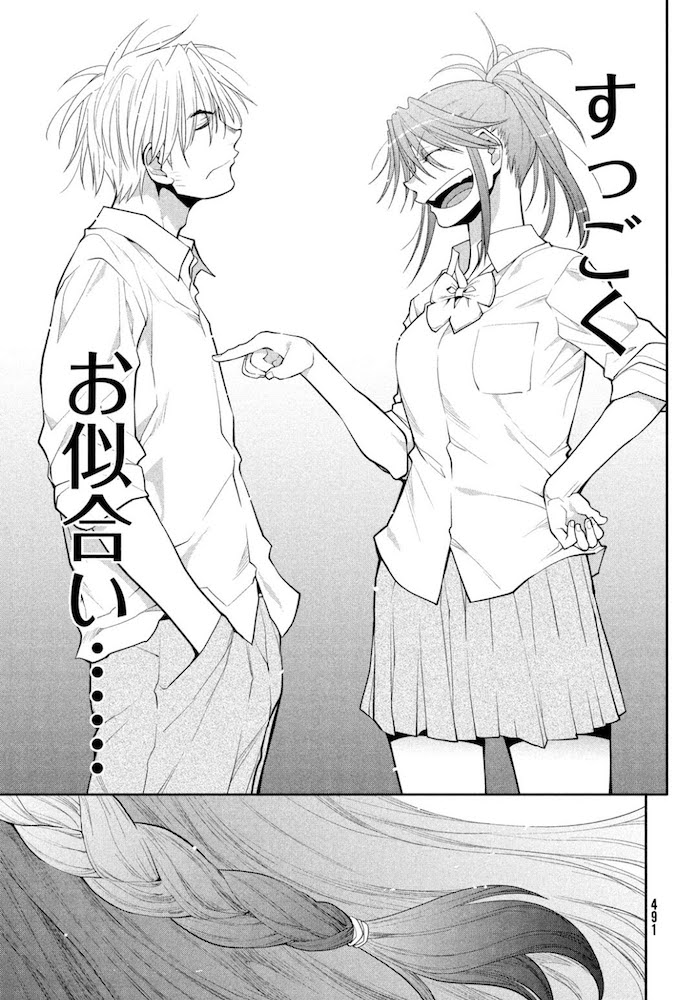
As Yukina is celebrating the win and talking with Kousei, Shion can’t help but think that they look great together. Suddenly, she sticks her arm between them and confesses directly to Kousei: “I like you. Go out with me?” Kousei’s response: “What? No.” That rejection is also the title of the chapter.
Yukina’s Turbo Controller
I genuinely thought that Yukina’s arm wrestling prowess wouldn’t really factor into the story beyond some displays of strengths, but here we are, with a sudden arm wrestling match. It almost makes regret making an Over the Top reference already. The surprise is welcome, however, and it adds to something I really enjoy about Hashikko Ensemble: the series is somehow both extremely predictable and unpredictable at the same time, and where those cards fall seems to just make for a more enjoyable manga most of the time.
All this arm wrestling talk also makes me think of my childhood playing the Track & Field II arm wrestling minigame. Whenever any arm wrestling happens in media, I just think of the background music and the grunting faces.
The Performance
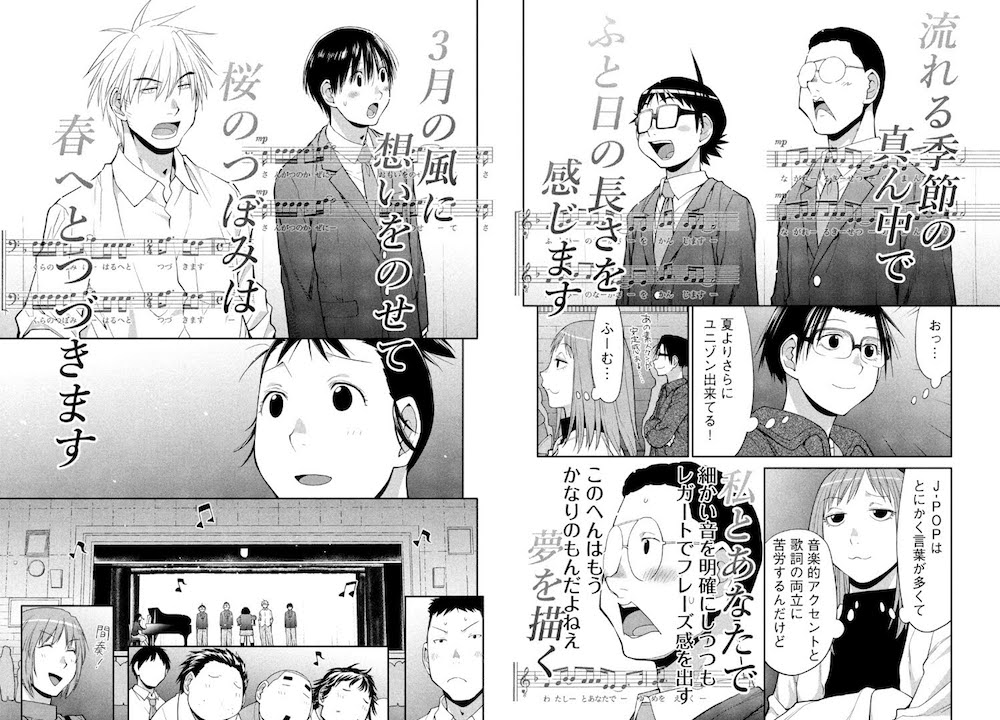
As the guys are singing, Takano-sensei makes mention of how much they’ve all improved (as well as Kozue’s excellent conducting). In particular, she remarks about their successful balancing of both the lyrics-heavy nature of J-pop with getting the right musical accents. She also uses a couple terms that I think are worth noting—mostly for my sake, as someone who’s not musically inclined.
The first is legato, which is singing in a smooth and connected way; the opposite of staccato. It is not, in fact, simply a Trigun villain.
The second is syncopation, which is singing on the weak beats.
The general idea, from what I can tell, is that they’ve managed to adapt a J-pop tune into something that utilizes the musical training they’ve all been going through. I wonder if the goal is to strike a middle ground between doing appealing songs to get more members and doing something technically impressive for Jin’s mom and her high standards.
Romantic Perceptions
It’s poetic that Akira has these dramatic nightmares about Kousei and Shion, but to Shion, Kousei and Yukina are the picture-perfect couple. There’s a self-consciousness at work in each case, where one sees themselves as somehow not looking “right” for their love interest.
I feel like this is a fear that Kio Shimoku tends to express and explore in his works. In Gonensei (The Fifth-Year), one of the core conflicts is how the boyfriend feels a level of inadequacy because he couldn’t graduate at the same time as his girlfriend, and the two drift further apart. In Spotted Flower, the husband similarly panics when he just lays eyes on his wife interacting with her ex-boyfriend, believing that he pales in comparison, despite the fact that he and his wife just had a daughter. I don’t think it’ll be anywhere near as dark and ugly in Hashikko Ensemble, but I’m interested in seeing how the love web continues to get tangled.
The chapter further contrasts how Shion and Yukina each see Kousei—the former as a strong hero and the latter as an adorable underclassman. As Yukina watches the performances, she recalls happening upon Kousei practicing his singing in private. Unbeknownst to Kousei, Yukina actually sat hidden behind a staircase, listening to him the whole time. It’s as if both girls have feelings because they’ve managed to see what’s on the inside, only it’s two different aspects of the “real Kousei.” If I had to give a preference, I like Kousei/Yukina, only because it’s more hilarious.
When the Tsun and the Dere are Indistinguishable
Right before the arm wrestling match begins, Kozue tells Sora to do his best. When he gets trounced by Kousei, she thinks, “Ah. Figures it was impossible.” While I originally thought that there was a possibility that Kozue might end up on a date with Sora reluctantly, it now looks like she might actually feel something for him after all. I don’t know if you’d call this tsundere, as I think that Kozue doesn’t have that characteristic loss of control of her own emotions, but maybe the childhood friend connection is real. Also, we haven’t seen what Sora looks like shirtless, but maybe he has the buffness she looks for in guys.
Or maybe being into musclemen is more of a fantasy fetish and not something she necessarily wants in a partner.
Songs
This month’s song is “March 9” by Remioromen, which the Chorus Appreciation Society performs against the Rugby Club.
Final Thoughts
During their performance, Akira’s mom is in the crowd. I don’t know why exactly, but seeing her cheer her son on and react like such a doting parent really sticks with me. Perhaps it’s just the way she seems so wholeheartedly excited about her Akira doing this new and different thing by getting into singing. I can sense the love in their relationship.
In a surprising move, the current Pokémon TV anime (called Pokémon Journeys in English and simply Pocket Monsters in Japanese) recently brought back the original super legendary, Mewtwo. And not just any Mewtwo, but the one who debuted over 20 years ago as the Viridian City Gym’s trump card. Mewtwo is my favorite character in all the anime, so there’s a personal thrill to seeing its return, but there’s added significance as well: the continued acknowledgement of the canonicity of events in and connected to the first film, Mewtwo Strikes Back, and an emphasis that what has happened over the anime’s long history still matters.
The Pokémon anime tends to play a little fast and loose with its canon, resulting in strange discrepancies, especially when it comes to the divide between the films and the weekly series. Aside from Mewtwo Strikes Back, whose plot ties directly into the TV anime, it’s always unclear—likely intentionally so—whether the events of the other movies actually “happened.” This isn’t unusual when it comes to films based on popular anime—nearly all the Dragon Ball Z movies are non-canon, and the popular movie-only character Broly had to be reintroduced into that universe in a canonical entry, Dragon Ball Super: Broly.
In the world of Pokémon, this has meant that, despite the fact that certain legendary Pokémon are meant to be the only one of their kind, Satoshi (Ash Ketchum) has encountered multiple versions. After he helped a telepathic Lugia save the world in Revelation-Lugia, he would later encounter a different one that could not communicate psychically and, in fact, was trying to raise a child (Lugia is not supposed to be able to breed). Even Mewtwo, whose whole story is that it is a one-of-a-kind artificial creation made to be unmatched in combat, would see a second distinct version show up in the 16th movie.
In the recent episode, there is no mistaking that the Mewtwo seen is the original. When it first appears, Mewtwo slowly descends as ominous background music from Mewtwo Strikes Back and the Mewtwo Lives TV special can be heard. When Mewtwo speaks, its gruff yet soulful masculine voice is that of the original actor, Ichimura Masachika, as opposed to the feminine voice of the 16th movie Mewtwo’s Takashima Reiko. And when Satoshi and Goh lay eyes on Mewtwo, their reactions couldn’t be more different: whereas Goh is shocked by seeing something unfamiliar, Satoshi and Pikachu immediately recognize the Genetic Pokémon and even say its name.
However, it’s not as if Mewtwo and Satoshi start to recall their two encounters. Mewtwo doesn’t even say anything about already knowing Satoshi, and Satoshi doesn’t bring anything up beyond that initial recognition. While this might be frustrating to fans who’d like to see a more concrete nod to Mewtwo and Satoshi’s connection, I think the current anime is trying hard to balance a lot of different paradoxical elements that exist within Pokémon and Satoshi himself. He’s somehow both the veteran with years of experience under his belt and the plucky young amateur who has much to learn—perpetually 10 years old for over 20 years. Satoshi’s many adventures have happened (including at least one film), but he’s also still meant to be an audience-representative character for young viewers tuning into the anime for the first time, even as Goh fulfills a similar role (though his character is closer to a scholar or researcher). Furthermore, by having Satoshi not say much, it reinforces the idea that he hasn’t let his previous experiences get to his head. A similar moment happens in the second episode of the current series, where Lugia speaks to Satoshi (and only Satoshi) telepathically, hinting that this one might just very well be the one we see in the second movie.
Trying to fully reconcile the Pokémon anime canon would be a foolish endeavor because it’s only as consistent as it needs to be in any one moment. Satoshi is forever a challenger, even as he wins championships. But given what the anime is trying to be, a long-running series that wants to feel both familiar and new at the same time, it’s not a bad place to be. And seeing the original Ichimura-voiced Mewtwo n the year 2020 is a nostalgic and thrilling experience. Mewtwo’s appearance speaks to the idea that the past of Pokémon still matters even as we continue to move into the future.
It might be serendipity that the same season a rapping anime comes out (Hypnosis Mic), we also see an anime about DJing: D4DJ First Mix. My early impression is that it’s pretty run-of-the-mill series rife with standard tropes of anime: cute girls doing an Activity, a Yu-Gi-Oh!-esque setting where DJing is the be-all and end-all, a plucky newbie with lots of potential, and a path that’s probably gonna lead to some tournament or competition to be the best. That being said, I am highly receptive to those tropes, and the fact that I know next to nothing about the world of DJs and have been trying to improve my understanding of music makes me an ideal audience for D4DJ First Mix’s beginner-level expositions.
There’s a lot that’s head-scratchingly awkward about D4DJ First Mix—little oddities that collectively make the show at times feel like an alien wearing a human skin. The title of the show is actually short for Dig Delight Direct Drive DJ. The show is done entirely in CG, bringing to mind Love Live!and Aikatsu!performance sections. The main heroine, Aimoto Rinku, is a Japanese girl who recently came back from Africa, and at least from early episodes it’s unclear what that’s supposed to mean for her character. At one point, she panics that the lunch she left out might get stolen by monkeys as a nod to her time abroad, but is her ability to intuitively sense the beat through her body supposed to be a result of her experience in Africa, or is it something more innate? The facial expressions remind me more of Virtual Youtubers or Comipo software models, like they’re aiming for a very conventional idea of anime aesthetic. This is doubly noticeable because of the sharp contrast between important and unimportant characters, the latter of which look like different versions of the “default” setting of a create-a-character mode.
When D4DJ First Mix does manage to overcome the quirks of its presentation, it actually does exude a real charm and charisma. The chemistry between the characters feels nice, and it feels earnest in actually teaching its audience about the world of DJing, and to grow a sense of appreciation for their hobby and passion. I can feel myself being pulled in, and I do wonder if some of what makes D4DJ First Mix feel strange is that it’s one of those multimedia projects (like Hypnosis Mic or Trinity Tempo) built around different character groups who are all supposed to garner their own loyal fanbases. If I stick with the show long enough, maybe I can find the team that’s right for me.
This post is sponsored by Ogiue Maniax patron Johnny Trovato. You can personally request topics through the Patreon or by tipping $30 via ko-fi.
Here we are, at lucky number 13. Toward the end of last year, I wrote a few posts about my feelings going into the new decade, unaware that the span from 2019 to 2020 would feel less like a year and more like a decade. As much as I would simply want this anniversary post to be about Ogiue Maniax proper, I can’t ignore that the world is in a strange and unusual place due to the effects of COVID-19 and the extremely uneven response to it around the world. The fact that we managed to deliver a defeat to the would-be dictator that we call the 45th President of the United States is at least some comfort, and I’m genuinely happy that I’m on the other side of the US election in a position of relative hope instead of soul-draining despair.
The pandemic has actually affected Ogiue Maniax in certain ways, and not just because I’m more readily willing to write about topics like it. For instance, in recent years, I’d been doing my writing during long train commutes to and from my day job. While not an ideal situation, I’d begun blogging on my smartphone as an efficient use of my time and as a way to decompress from the work day while also fulfilling my personal standard of at least two posts per week. If I didn’t feel like writing, I might read manga (whether paper or digital), listen to podcasts, play games, or any number of activities that could become the fodder for future blogging. But now, I have no commute to “fill up,” so I’ve had to adjust my habits again, accounting for this shift in routine as well as my personal mental and emotional status. Which is to say, I’m not traumatized to the point of inactivity (as any regular readers would notice), but I definitely can’t say I’m unaffected.
Even the travel I would have done—a combination of personal, professional, and blog-oriented excursions—have been kiboshed. Gone are the conventions like Otakon, Anime Expo, New York Comic Con, and Anime NYC. What would have been a trip to Japan next year is highly unlikely for the foreseeable future. I’m one of the many who picked up Animal Crossing as a way to connect to friends, and I’m sure that has influenced my media consumption in some ways as well. Ironically, I’ve worried in the past that I haven’t done enough individual reviews of anime and manga, and now I’m worried I might be doing too many. I used to think nothing could keep me from Otakon, but I did not expect a deadly virus to upend the world. Silly me.
One bright spot among all this is that Ogiue Maniax’s site views are actually trending upwards for the first time in about eight years. In recent times, I’ve been lamenting the declining popularity of anime blogging at the same time I have been reluctant to move from the format, out of some combination of stubbornness and comfort. However, when I looked at my site stats recently, I noticed that almost every month in 2020 has been better than the last in terms of exposure; curiously, it seems to have begun in March and April. So while I have no concrete evidence at hand, I have begun to wonder if the pandemic has been a significant influence on my readership. Could it be that with so many people at home now, they’re willing to read my blogging? I appreciate the increased hits, but I would trade them for a world not in the grip of a plague.
I really, really, really hope next year’s blog anniversary sees us all in a better place.
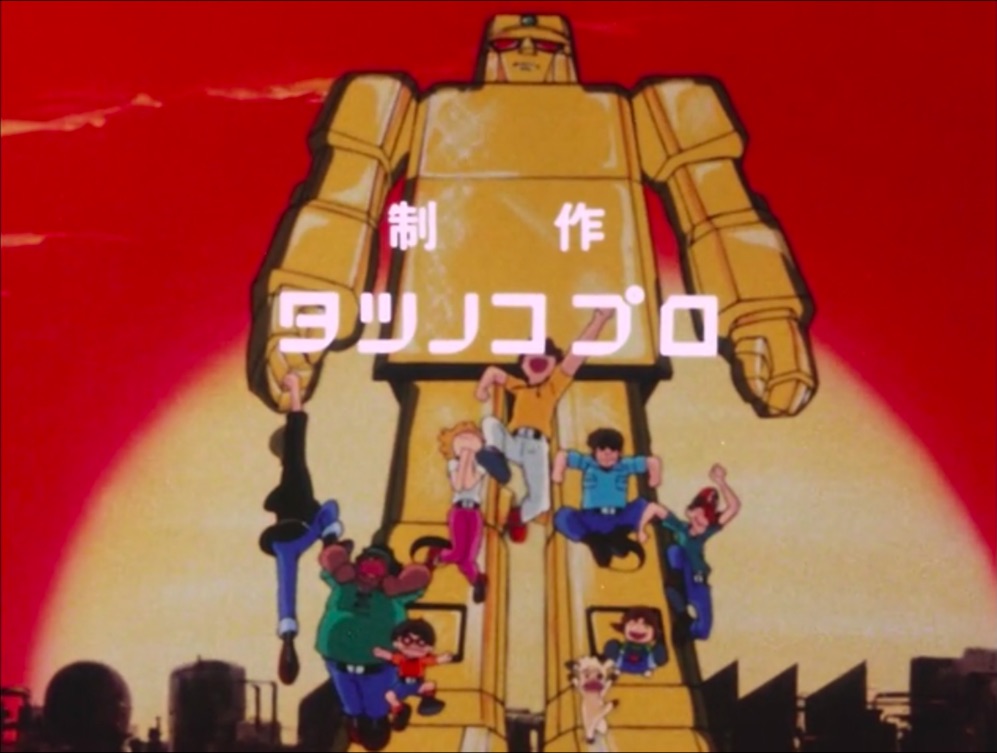
I don’t remember exactly where I first heard of the 1981 anime Golden Warrior Gold Lightan. I think it might have been one of those English-language anime magazines, like Animerica or Newtype USA, where a writer imagined the bizarre board meeting that would allow a sentient Zippo lighter to be the star of a children’s TV show like some tobacco ad gone horribly wrong. But it was during my study abroad in Japan that I had the opportunity to check out the series firsthand, thanks to my college’s extensive anime DVD library. Unwilling to devote my entire time in another country to just watching Gold Lightan of all things, I watched a smattering of episodes just to get an idea of the series a whole: the first few episodes, some from the middle point, and the very end.
Gold Lightan turned out to be far wilder than I had imagined, as it could easily swing from boring “monster of the week” fare to intense melodrama at the drop of a hat. Its backstory alone is ridiculous but played straight: the narrator explains how villains from the “mecha dimension” aim to conquer our third dimension, as if they go in order from 1st, 2nd, 3rd, to “mecha” in the most natural way. The titular robot transforms itself from palm-sized lighter to metallic titan by shouting “RAINBOW ROOOOAAAD!” and emerging from a massive wormhole after being sent through a prism. Despite being just a chunky yellow block with arms and legs, Gold Lightan animates surprisingly well in combat. Intense fight scenes end with a brutal finisher that would make Kano from Mortal Kombat proud—the “Gold Finger Crash” involves thrusting a hand into the enemy robot’s chest to pull its mechanical heart out. The anime concludes with a finale that looks closer to the trauma of a Tomino-directed Gundam.
Against all odds, Gold Lightan is currently licensed and streaming legally in the US thanks to HiDive under the name Golden Lightan. It’s already been almost a year since the announcement, and in this time, I’ve taken to re-visiting the series every so often with the hopes of doing what I hadn’t in Japan: watching the entire series. Now, fifteen years after I first laid eyes on this bizarre anime, I’ve come to the conclusion that Gold Lightan just has an absurd amount of effort put into it by everyone involved. It’s as if the studio behind the series, Tatsunoko Pro, saw the inherently weak premise as an opportunity to just flex on everyone with their animation chops.
But that’s what Tatsunoko has always been known for: a high level of detail when it comes to animating action. Its animators pioneered elaborate explosion effects and particle animations, and the studio as a whole as a history of sleek and stylized works ranging from Speed Racer to Gatchaman to KARAS and on. What’s bizarre to me is how moments of intensely beautiful animation can show up in Gold Lightan at seemingly innocuous moments. In one episode, one of the kid characters powers up his little go-kart for a ride, and just watching the engine roar to life and the exhaust pipes bellow and shift tells me that someone had to have dedicated themselves fully to getting this throwaway go-kart scene juuuust right.
I think the modern equivalent of Gold Lightan’s attention to quality is when an anime about some free-to-play, wallet-draining mobile game turns out to be one of the big hits of the season. The difference is simply that times have changed, trends have shifted, and these mobile game anime are a mere 13 episodes instead of a whopping 52. I’d recommend Golden Warrior Gold Lightan to those who want to check out the more obscure side of giant robot anime, to those who want a show where effort overcomes a paper-thin concept, and (I’m not kidding) to sakuga fans who just revel in seeing things lovingly animated with skill and grace. It’s a ridiculous and wonderful time.




 OGIUE MANIAX