
My very first post as a writer on Apartment 507 was speculation that JAM Project would soar in popularity thanks to One Punch Man. Now, I’ve written a follow-up due to the group’s recent performance at Otakon 2017. Check it out!

My very first post as a writer on Apartment 507 was speculation that JAM Project would soar in popularity thanks to One Punch Man. Now, I’ve written a follow-up due to the group’s recent performance at Otakon 2017. Check it out!

This review is part of Ogiue Maniax’s coverage for Otakon 2017
Of the many Japanese creators who tackle the subject of Japan in World War II, manga artist Kouno Fumiyo has stood out perhaps more than any other over the past decade. Avoiding overt criticism of the war, she tells stories from intimate civilian perspectives instead of focusing directly on the horrors of war or the battles themselves. Her first notable work, Town of Evening Calm, Country of Cherry Blossoms, is about how Hiroshima coped with the aftermath of the atomic bomb from the ground-level. Her second major title, In This Corner of the World, has now been made into a feature film, and the transition from page to screen captures the pain, nostalgia, and conflicted emotions of the wartime period in subtle yet profound ways.
Directed by Katabuchi Sunao (Mai Mai Miracle), ITCotW follows a young girl named Suzu, an airhead with a talent for art who grows up in 1930s-1940s Hiroshima City. As she reaches adulthood and moves to nearby Kure, her everyday life slowly changes, chipped away by the surrounding reality and the ever-encroaching war. She and her family make the best of their situation, able to smile and laugh even in the most dire situations, but the war takes its toll and truly tests Suzu’s ability to go on living.
Avoiding clear-cut criticism of Japan’s actions during WWII carries an enormous risk. Suzu, who lacks of education and tends to just go along with whatever happens to her, can be seen as a lack of critical examination of the war, as well as an overly idyllic portrayal of Japan at the time. However, the film uses both the surrounding environment and Suzu’s portrayal to show how, underneath the facade of imperial prosperity, lies the gradual degradation of what it means for the world to be “normal.” A trip to a school includes young girls singing propaganda, unaware of how it is indoctrinating them. When Suzu witnesses an aerial battle, she is shown imagining it as splashes of paint, the aesthetic beauty of it peering out before the harsh image of destruction returns her to reality.
ITCotW risks being interpreted as celebrating Japan’s glorious past, or at the very least portraying Japan and its citizens as mere victims of war instead of being a major player. The film does not address the atrocities Japan committed, nor does it ever show anything but the fight on Japanese soil. Yet I do not find the decision to avoid confronting such topics head-on to be a crime by omission. I think that, within Suzu and the other characters’ lack of extensive examination is an exploration of how even those who tried to live ignoring or being unaware of Japan’s position are ultimately thrust into it, whether they liked it or not. Not everyone has the strength to risk themselves challenging the establishment, but even those who try to go with the flow can find themselves challenging the tides in small ways.
Another aspect of the film is that it does not utilize the typical images of World War II. When the atomic bomb hits Hiroshima, it does not show the infamous mushroom cloud we all know. Moments later, they look towards Hiroshima, and at the cloud that has begun to lose its shape. The fact that most of the movie takes place outside of Hiroshima is also a clear intent to examine life in wartime outside of the expected locales.
As the film progresses, it moves from beautiful to hauntingly so, a reflection of how the characters, their world, and their sense of normality wear away. A major tragedy in the middle of the film brings about in Suzu a struggle to hold onto the things that have allowed her to take everything in relative stride. How she emerges from that challenge becomes itself indicative of a nuanced message about the perils of patriotism.
At AnimeNext 2017 back in June, I got to speak to the staff of the anime Re:Life. It was a short but informative interview that also went into other shows they’ve worked on, including an anime from the same studio as Kemono Friends.
Re:Life is about a man who gets the chance to relive his high school days. When creating and animating the show, is there anything you had to consider in terms of body language, such as how an older man would act or move that a younger man would not?
Yamanaka Junko: So in terms of body language, by the time you’re 17 you’re pretty much grown as a male. So in terms of the body itself, nothing really changes between 17 and 27. If anything, it’s more the voice actors and actresses who have to portray the 10 years of change, of mental instability.
My next question is for Ueda-san. You worked on a very humorous anime called Tesagure! Bukatsumono. What was it like? It seems like a very unique and interesting experience.
Ueda Reina: Pertaining to this particular series, what we would do is record three minutes of airtime for one hour. There was no dialogue written out. The beginning and ending were set but everything in the middle was all ad-lib. So for the next fifteen minutes, we would do three-minute segments of ad-libbing the entire time, and then we would take multiple episodes in one day. During the set, the actual recording process, there was so much laughing because everyone was laughing at each other’s ad-libbing. It was really fun to work on.
Yamanaka-san, you’ve worked on Detective Conan for many years, on multiple movies and the TV series. When working on the series, are there any golden rules that you must adhere to, like things you must do to make it feel like Conan?
Yamanaka: Someone has to die (ha ha).
The dart hitting Kogoro is an iconic moment.
Because it’s a story about detectives, the actual solving part is where we spend the most energy.
Because Re:Life is about NEETS and redoing your past, do you think this is a more universal or timeless theme, or is it specifically relevant to modern times?
Yamanaka: This is a very difficult question because it’s hard to assume things, but the perspective of the NEET has been around for a while, and the creation of the word is further back. Maybe it’ll still be timeless, but it’d be better for Japan if this is not timeless, and no one remembers what a NEET is anymore.
Thank you for the interview!
Ash Ketchum (Satoshi in Japan) is an ageless character. Whether it’s 1998 or 2017, Ash will always be 10 years old, will always be traveling with Pikachu, and will always be just not quite good enough to win a major championship. When he’s fighting through Kanto or Kalos, he won’t dominate the competition with his massively powerful Pikachu, and he’s perpetually more of a learner than a master in spite of his experience. It makes sense, because that’s how his character’s supposed to be. When he points his Pokedex at the same Pokemon for the 10th time in 10 years, it’s not because he’s supposed to be dumb but rather for the sake of a young audience who might be watching Pokemon for the first time.
Ash doesn’t always act as the impetuous rookie, and at times he’s allowed to shine as the battle-hardened veteran. Curiously, however, these mainly come when the Pokemon anime is not trying to go through its main narrative. During the filler arc that was the Orange Islands (taking place between the first and second generations of games), Ash was allowed to have a 6 on 6 battle and even defeat the Orange Islands champion. When Ash was participating in the Battle Frontier, post-game content within the context of the games, he would call upon his entire previous roster. The opening video during that arc reflected the full range of Ash’s experience by showing every Pokemon at his disposal (and even cameos by ones since released such as Butterfree). Ash eventually won the Battle Frontier, again showing how strong he was, but only within the between-games storylines.
Perhaps the biggest exception to this rule was when Ash finally got to face Gary in a full on 6-on-6 battle in the Johto League finals. The context behind this was that Gary’s Japanese actor was taking on less of a role in the series so they wanted him to go out with a bang and they succeeded. Just like his eventual Battle Frontier victory, Ash was allowed to show just how much he had learned over the years, at least for one climactic confrontation. It reminds me of how the Archie Sonic the Hedgehog comics kept running even during the years-long lull of no new Sonic games, and it was during those times that they dared to go as far as killing Dr. Robotnik. To a lesser extent, it makes me think of how during the infamous Naruto year-long filler arc, characters such as Hinata were allowed to get new techniques and grow more powerful.
I find Ash’s situation this interesting because it reflects both the realities of making an anime based on an wildly popular game and a desire to provide continuity or growth when the opportunity arises. Ash has to be eternally youthful, yet his viewers grow up and remember all of his adventures. The anime’s creators likely also have to mindful of the source material, especially as the series has grown to such international success (the earliest seasons played rather fast and loose with the rules).
What do you think of this balance? Do you wish Ash could be 20 years old by now, training atop a mountain like Red in Pokemon Gold, Silver, & Crystal?

The Precure Pretty Store in Tokyo has a new batch of idol-style merchandise around the theme of “summer festival.” For it, each of the girls are wearing special outfits and have been separated into different groups around a common theme.
While that’s not unusual in itself, what I find fascinating is that the groups for the most part are not along traditional lines, like “show origin” or “color.” In fact, there doesn’t seem to be any real consistency from one theme to the next. Even so, I think it provides a new perspective on shared values between individual characters, so I’ve decided to lay out the categories below.

Pro Celebrities: Kasugano Urara, Amanogawa Kirara
 Love: Momozono Love, Aino Megumi, Aida Mana

Otherworld Singers: Kenzaki Makoto, Kurokawa Eren

Fantastic Dreamers: Haruno Haruka, Yumehara Nozomi, Asahina Mirai

Athletes: Misumi Nagisa, Hyuuga Saki, Natsuki Rin, Hino Akane, Midorikawa Nao

Wildly Expressive: Kurumi Erika, Shirayuki Hime

Bookish Glasses Girls: Yukishiro Honoka, Hanasaki Tsubomi, Tsukikage Yuri, Shirabe Ako

Fairies-turned-Precure: Hanami Kotoha, Mimino Kurumi

Creators: Mishou Mai, Akimoto Komachi, Hoshizora Miyuki, Kise Yayoi

Martial Artists: Myoudouin Itsuki, Aoki Reika, Yotsuba Alice, Hikawa Iona

Musicians: Minazuki Karen, Houjou Hibiki

Secret Hard Workers: Aono Miki, Izayoi Liko

Chefs: Kujou Hikari, Minamimo Kaede, Madoka Aguri, Oomori Yuko, Usami Ichika

Aspiring Doctors: Yamabuki Inori, Hishikawa Rikka, Kaidou Minami

White-Haired (Former) Villains: Eas (Higashi Setsuna), Twilight (Akagi Towa)

Princes: Coco, Natts, Masame Oji, Kanata

Villains Disguised as Schoolboys: Kiriya, Luntaro (Wolflun), Kurosu (Close), Rio (Julio)

Young Mascot Fairy Boys: Syrup, Pop, Rakeru, Rance, Aroma

(The One Exception) Kira Kira Precure a la Mode: Kenjou Akira, Tategami Aoi, Kirahoshi Ciel, Usami Ichika, Arisugawa Himari, Kotozume Yukari
So what do you think of these categories? Do you like thinking of Precures along these lines? The one category that still perplexes me a bit is “Secret Hard Workers,” because Liko and Miki have very little in common. Is there something else they have in common that I’m missing?
And where would the a la Mode girls fit if they had to be divided into them? Would they all go into “chefs,” or would that only work for some of them? For example, would Aoi fit better in “Musicians?”

Yuri fans have long been into Precure, but a recent episode of the newest series placed yuri front and center into a world that normally shies away from such a direct presentation. See my thoughts on how character age has paved the way for yuri in Precure at Apartment 507.
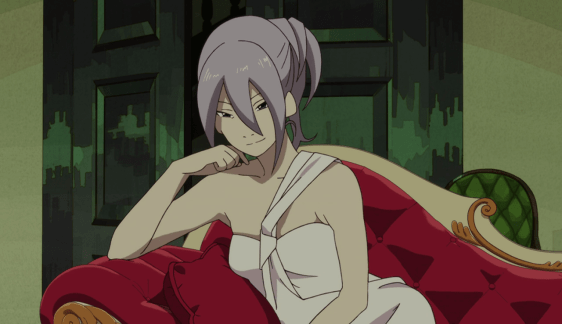
The Eccentric Family (Uchouten Kazoku) is an anime series of many strengths. Utilizing Japanese mythology to tell a humble yet sprawling tale of family and community, its characters all stand out in different and interesting ways. Of the cast, arguably the most compelling is Benten, a human woman with the powers of a tengu, a divine creature with control of the wind. The original series establishes her as beautiful, powerful, and able to string characters along with the greatest of ease; in a way, she’s a little too perfect, which is why I’m especially impressed that the sequel, The Eccentric Family 2, devotes itself to showing an heretofore unknown side of Benten: when things don’t go her way.
Benten’s teacher is Akadama, an old tengu with injured wings who is incredibly smitten with Benten—something she uses to her full advantage. The Eccentric Family 2 introduces a character called Nidaime (“The Second”), the estranged son of Akadama. As the fallen successor, Nidaime is an incredibly powerful tengu in his own right, and proves it by actually besting Benten in combat. It’s clear how this impacts Benten, who up to this point has been unchallenged. To make a comparison to Dragon Ball Z, Benten is like Freeza: someone who could fight more or less unopposed and thus when it came time to push herself was unaccustomed to doing so. Upon her first defeat, we see Benten training. Even going so far as to visit Hell and wrestle oni.
When Benten and Nidaime finally have their rematch, they’re far more evenly matched, but another of Benten’s strengths, her beauty, is ultimately her downfall. During the fight, Nidaime sets Benten’s hair on fire, and for the very first time in all of The Eccentric Family, she is emotionally compromised. Her scream of horror as she realizes what’s happened to her is so unexpected that, at first, it seems like she’s just playing both the audience and the characters, like she always does. Then, as she falls into the water, it becomes clear that this is no act.
Moreover, Nidaime’s attack highlights another aspect of Benten’s character: how aware she is of her own attractiveness, and the extent to which she actively cultivates it. She clearly knows that her hair, as part of her overall appearance but also as a symbol of erotic feminine beauty, contributes to her aura. It’s what allows her to manipulate everyone, from lowly tanuki to humans to tengu. Losing her hair is akin to losing a significant part of her power and influence.
Benten, in this Ivan Drago-esque position of becoming self-aware of her own mortality, becomes similarly sympathetic to the Soviet boxing champion. She was already a fascinating character, but now you can see the subtle cracks in her armor. Benten doesn’t seem like the type to change significantly or to turn a new leaf, but she goes from being the pinnacle of perfection to someone who perseveres in trying to maintain that infallibility.
Today’s anime industry is filled with light novel adaptations, many of which revolve around tropes that are loved by some and hated by others. Common ones include ridiculously long and descriptive titles, an average passive guy who discovers a special power, and the throngs of girls (some of whom may or may not be his little sister) who fall for him as he saves the world. For those who aren’t fans, the term “light novel anime” has come to be filled with a certain level of apprehension. “Oh, it’s a light novel anime, but don’t hold that against it.” However, while the contents of these stories contribute a large part in why they draw ire from some anime fans, what I think is an equally important factor is the implication that a good deal of money is required to adapt a light novel into an anime.
Generally speaking, the “light” in light novel refers to the fact that they’re supposed to be light reads. Sure, they might be full of esoteric jargon (hello Index) and long and complicated word play (Monogatari), but for the most part light novels are meant to be easy to pick up, finish, and put down. It doesn’t cost much to write a light novel, relatively speaking: it’s usually one person writing, and one person doing a handful of illustrations. Overall, while the industry itself isn’t necessarily cheap, the act of writing requires only a pen and paper (or keyboard and computer).
Imagine you’re presented with a book that’s full of the same tired elements, and even reeks of some author’s self-insert revenge fantasy. Its prose seems stiff and workman-like, without any creative flair. You read it, make a face, and then put it away. No harm, no foul, and even though you might later find out it’s popular and don’t personally understand why, this simple “light” book is no skin off your back.
However, then you find out that the book is being made into a Hollywood movie. They’re pouring millions of dollars into it. It feels weird, almost as if it weren’t meant to stand on this grand of a stage.
This, I think, is akin to what happens sometimes when a light novel gets adapted into an anime. Of course, there is much, much less money in the anime industry compare to big budget films, but there’s still a transition from a light novel, a piece of fiction similar in function to old American pulp magazines, to something that requires funds, hiring of talent in great numbers, and just a great deal of combined energy. As Shirobako has shown, anime production is a grueling process, and the idea that the anime industry is putting all of that energy into making some bad light novel look good can seem to detractors like a waste of finite resources.
The industry standard for the “look” of anime involves a certain higher level of polish and presentation. Most shows on a very basic level pass the test of “does this look like it was drawn and created by professionals?” What this means, then, is that whether an anime is based on some award-winning novel or something else entirely, they have similar levels of professionalism. The amateurish qualities of a light novel, which might have been forgivable for more people if they remained in that realm, vanish, and this causes fans to look at these stories from a different perspective.
In other words, if all light novel anime looked like gdgd Fairies or Ai Mai Mii, I don’t think they would get quite as much hate. Actually, that’s something I would love to see.

Otakon is this month! With guests like the director of Eureka Seven, JAM Project, and more, I’m unbelievably hype for this year’s convention. If you happen to spot me at the con, feel free to say hello.
Thanks to all of my Patreon sponsors!
General:
Johnny Trovato
Ko Ransom
Alex
Diogo Prado
Viga
Yoshitake Rika fans:
Elliot Page
Hato Kenjirou fans:
Elizabeth
Yajima Mirei fans:
Machi-Kurada
I want to talk about Twitter for a bit. In the past, I’ve never really had any of my tweets go wild; the most successful one I had for the longest time was this:
That was almost two years ago. But all through July, I’ve been hitting it out of the park in ways I hardly expected. I was never good at the social media game, so seeing my tweets go viral again and again is hard for me to wrap my head around.
Have I figured something out? Only the future knows…
Anyway, here are monthly post highlights:
Gattai Girls 6: The Super Dimension Cavalry Southern Cross and Jeanne Fránçaix
After three long years, it’s finally the 6th entry in Gattai Girls review series! I look at mecha anime starring female robot pilots.
Pre-Evo Thoughts: Video Games vs. Chess Analogies
Gamers love to say that their favorite game is comparable to chess. But couldn’t we think through the analogy more?
Bootleg Products and the Defiance of Value
Bootleg stuff is often either demonized or written off as harmless, but what effects does it have on a fandom’s ability to grow itself?
Patreon-Sponsored
Aikatsu and the Power of Not Running Jokes into the Ground
The Aikatsu !posts continue! This month, I look at how great the humor is in this series. You might think I’m being paid by the creators or something, but it’s just that my biggest patron is a huge Aikatsu! fan!
Return to Genshiken
Return to Genshiken: Volume 4 – Ogiue Descends
Ogiue’s finally here! Starting this volume, I’ll be using the Japanese books along with the English ones for my re-reads.
Closing
Hopefully the next Gattai Girls post won’t take nearly as long. I’m waffling between… Patlabor and BBK/BRNK. What do you think?
Anyway, see you at Otakon!
Last time, I asked the illustrious Studio Trigger about the origins of Turning Girls. This time I only had the chance for one question to Yoshinari Yoh (director of Little Witch Academia), but the answer was quite informative.
When you were a lowly footman in the anime industry, what did you swear you’d do when you got further? Like, “If I ever become director, I will definitely do this.”
Yoshinari Yoh: When I just entered Gainax, it was right when Sailor Moon was airing, and I was reading an article in a magazine. I remember commenting, “I would never want to do something about magical girls.” But then once I entered Gainax, the executives (such as Anno) loved Sailor Moon, so I ended up working on it.
Thank you for the interview!

