2010–2019 Part 1: Prediction Results

Ten years ago, I made a blog post titled 2000-2009 Part 2: Looking Forward, where I tried to foresee where anime would go over the next ten-plus years. Now that we’re in 2019, it’s time to see how it turned out!

The First Digital Generation

In about 20 years or so we are going to see an entire generation of adults in Japan (and around the world) who have grown up primarily on digital animation…. Over time, I think that the peculiarities of digital animation, such as the computer-based shortcuts, will become part of the style itself, but less direct about it than, say, Studio SHAFT’s current output…. But if there are any, they will be making in-jokes and references about the early, nostalgic days of digital animation and not light boxes and such.

For better or worse, as a new range of ideas and techniques emerge, parts of animation technique and philosophy born out of cel-based anime will fade away, perhaps forever. After all, Miyazaki can’t live forever.

Digital animation has been embraced in full, with the last cel-based series, Sazae-san, switching over to digital in 2013. The style of early-2000s anime is understood, but the nostalgia for anime is still somewhere in the 1990s, so we haven’t reached the point where those early digital animation works and their aesthetic are a part of the cultural lexicon.

While digital animation is the industry default now, it’s not as if the more daring uses of digital animation have become standard. At the same time, I would argue that integrating 2D and 3D animation has been much more successful—something that is made easier by the transition to digital. Two works that stand out to me in this regard are Girls und Panzer and Kids on the Slope.

As for Miyazaki, he’s still around, and he’s coming out of retirement for what may be the 500th time. He also used this decade to make one of his most daring films ever, The Wind Rises.

Flash Animation

In light of the anime industry’s history of low budgets, I think that more companies, be they animation studios, broadcasters, or otherwise, will start to look at Flash as a viable method to keep things low-cost and at-home. Now I don’t think it will eliminate today’s more “traditional” animation, especially when it comes to bigger-name, bigger-budget works, but it will be an appealing tool for those middle-of-the-road shows, and shows for kids.

Nothing dates a prediction post quite like hyping up outdated technology and programs, huh! The world, including the anime industry, has moved away from Flash animation, but the simple, flat style can still be seen in the many short anime (as in 13 minutes or less) that have come out since, such as Inferno Cop and Ai-Mai-Mi.

Looking away from Flash specifically, many tools have emerged that facilitate creating anime with limited resources. Most notable among these is the 3D animation program Miku Miku Dance—itself an extension of Vocaloid as an artistic tool for creators both professional and amateur—and the bizarre yet endearing shows that have been made using MMD. Most of the time, that meant oddities like gdgd Fairies and Tesagure Bukatsumono, but also the surprise smash hit that was Kemono Friends.

Changing Views on Hikikomori and NEETs

The chronic shut-in known as the “hikikomori” is a topic that Japan for the past decade has been in debate over….

But the reality of the economy is such that not having a good job (or a job at all), living at home, and having your parents’ support will be an increasingly common sight. Some will become hikikomori and try to close themselves off from the world, but there may be a sizable group that is only partially hikikomori, who will not completely lose their ability to interact with others or to engage in meaningful activity, and they will have a cultural and social “pulling” effect on the full-blown hikikomori….

The result may be that Japan’s view on the hikikomori and the NEET, especially in the face of having these groups increase in size, will be a mixture of greater panic and greater relief as they will fret once again that this is potentially very dangerous for Japan, while the internet will provide this larger hikikomori population with the group setting in line with Japanese ideas of “group….”

In many ways, the image of hikikomori and NEETs hasn’t changed that much, with the same criticisms about them being a drain on society still persisting. I think one thing that is becoming clearer and clearer to the younger generations both in Japan and around the world is that the blame cannot be laid squarely at the feet of the shut-ins. The adults of the world have failed the youth on some level, and the kids are only starting to fight their parents in the street to find out who’s right and who’s wrong.

There’s also been a rise in a kind of “NEET pride” that permeates anime, most notably in the ascendancy of light novel isekai—series that often have hikikomori heroes who possess powers tied to their previously less than stellar lives. In a good work (e.g. My Youth Romantic Comedy Is Wrong, As I Expected), these characters, and their struggles and growth, tell stories about being human.

Perhaps no example is bigger than the transformation seen in No Matter How I Look At It, It’s You Guys’ Fault I’m Unpopular, aka Watamote, started off in the early 2010s as the story of an utterly hopeless otaku girl whose personal vices made her a relatable character to the self-proclaimed losers of 4chan. Despite Tomoko’s seeming fate as a perennial failure of a human being, even she has begun to change in the series.

Thematic Responses to the Economy

In about three to five years, I predict that we will begin to see both anime and manga which address the idea of global recession itself and incorporate it into the themes and settings in these works, to have it become a concept that is to be explored, whether directly or indirectly. Evangelion and other shows were responses to the recession that befell Japan starting in the early 90s, and I don’t think it would be unusual for an international economic downturn to have a similar effect.

With the global recession on everyone’s minds 10 years ago, it’s no wonder that I thought it would become a bigger subject. There have been anime that touch upon money and politics, but it’s not as if there was a huge influx. Back in 2009, Japan was already in the middle of a decades-long recession, so it didn’t affect them quite in the same way it did the United States. Instead, it would be tragedies like the Fukishima Triple Disaster that would highlight the real cost of greed and neglect.

While there were few anime made in response to the global recession, there were series that tried to highlight the challenges of political participation and governance ethics in the second decade of the 21st century, such as Psycho-Pass and Gatchaman Crowds.

The New Escapes

There are two basic forms to “escapism.” The first is a type of introverted escapism, that is, to become increasingly insular. The second is an extroverted escapism, where you want to project outwards, to go beyond yourself….

In that sense, I think that in the near future the escapism for anime and manga will be increasingly introverted, but will soon give way to a more extroverted form as a response to the desires of more and more fans who want to be released into other worlds…. I think we will see a lot of stories about worlds with wide scope focused through the lens of personal characterization, and in a way in which the former affects the latter significantly and vice versa.

One of the big genres of the 2010s has been isekai, i.e. being transported or reborn in a different world, and I think that it is a prime example of mixing both internal and external escapism. There is literally another world to explore, and the protagonist is often simultaneously special and unspecial, allowing readers to indulge in both dominant power fantasy and being the underdog. But there is often a lingering awareness of who the protagonist was in their previous life, and in a sense, their fears and doubts are still akin to the more introspective and flawed heroes of the past.

It’s also this decade that Madoka Magica took fandom by storm, and while that series isn’t exactly lighthearted, it too feels like a work responding to the desire for stories to be both more internal and more external. And when it comes to looking inward but going beyond, My Hero Academia is a series where that’s a central theme. You can even extend this to series such as A Place Further Than the Universe, where instead of going to another world, the characters find themselves through a journey to Antarctica.

Increased International Integration in Collaborative Efforts

…I predict that over the next decade and beyond, we will be seeing collaborations on animation and comics where the staff producing these works will be much more closely integrated. International collaboration isn’t new to manga and especially not to anime, but the work is usually cleanly divided between the countries involved. So it’ll be less Gurihiru drawing for Marvel’s Power Pack and more Oban Star Racers.

This decade saw more and more international artists working in anime and manga. Thomas Romain, who worked on Oban Star Racers, is a staple of Studio Satelight shows. Animators such as Bahi JD from France contribute the world over, whether that’s Toei Animation’s Philippines division, or freelance animators outside of Japan working on key frames/genga on a variety of shows.

But one other big development has been foreign funding for anime, especially through Netflix, which solidified itself as perhaps the go-to streaming services and has been expanding into anime ever since. In some cases, such as with Devilman Crybaby, the production team and creative is still mainly Japanese. In others, such as LeSean’s Cannon Busters, they’re developed cooperatively with artists and creators abroad.

Another important note is the success of Studio Trigger (Little Witch Academia, Kill la Kill, Promare) in their desire to appeal internationally. Many studios attempt this, but I think it’s Trigger that has best understood the international market, especially the Western market.

Age Demographics in Japan vs Age Demographics Abroad

…I believe that in time the manga audience in the US will slowly mature and eventually reach a point where they want something that is more in-line with how they feel about entertainment, their lives, and the world at large.

The key however will be whether or not Japan realizes that age demographics do not map one-to-one between Japan and the US … and they will have to somehow find a way to understand just what this slightly more matured manga-seeking audience is looking for, possibly through the greater international collaboration.

I think the overall maturing of the anime fandom abroad has happened in a big way, and it’s clear from the kinds of series that have found better success over the past ten years, and it’s not just because people got older. While shounen fighting and other popular genres stay evergreen, I believe that stranger-looking series such as Land of the Lustrous and JoJo’s Bizarre Adventure needed the non-Japanese fandom to develop to the point that they could be better appreciated. There’s also the increasing popularity of sports series, which were once a death sentence in the United States.

As for Japan understanding that age demographics don’t line up, I think it’s happening because they themselves are aware of it happening in Japan.

Multimedia Customization

I think that starting in the next few years this is all going to start changing until we reach a point of personal customization in our anime and manga: You will be able to make exactly the purchase you want with exactly the things that you want, on-demand.

This definitely did not happen. In fact, we’ve seen some companies release even more deluxe editions that only hardcore fans willing to shell out $400 or more can ever obtain. At the very least, many of these expensive series are available streaming, thus giving access to those who can’t afford to own them.

New Paths for New Talent to Appear

I think anime is heading in a direction where people won’t have to be skilled at every aspect of animation production to be considered a Big Deal. One possibility I’ve thought of is “anime festivals” for amateur creators, be they industry-sponsored or independent, with competitions and awards for categories such as storyboarding and writing in addition to full-on animations. More importantly however, these anime festivals could take place entirely online.

Manga too will start to have online festivals…. It’s not so much specialization as it is realizing again that not everyone talented is multi-talented.

While there’s nothing quite like an online-only Comic Market, there have been projects to encourage new artists.

On the anime side, three main examples have emerged as opportunities for young animators to show their skills. First is the Young Animators Training Project, which has less experienced Animators animators work with established studios to create anime shorts. Little Witch Academia is probably the most famous work to result from this. Second is the Japan Animator Expo started by Evangelion director Anno Hideaki, which encourages more experimental work. Third is the more practical Animator Dormitory Project, a crowd-funded way of giving young and old artists a place to blunt the cost of living in Tokyo on a meager animator’s salary.

On the manga side, I look less at the competitions which exist and more at the fact that sites like Pixiv have brought about a number of success stories. Among the series that began as amateur webcomics on Pixiv are Skull-face Bookseller Honda-san and Wotakoi. Seeing them go from creator pages to Pixiv Comics to physical releases to full-on anime adaptations has given me joy.

Overall

I’d say I was about 50/50 in terms of predictions. Nothing hit the target dead-on, but I think I was able to see at least in part the various trends and where they were headed. In some cases, I was maybe too ambitious or naive. Let’s see how I do in the next ten years, but before that, next time will be a more thorough look back at 2010–2019.

Hand in Hand: “Teasobi” Final Review

Teasobi, the slightly “scandalous” hand-holding manga, recently concluded in Japan. From Ootake Toshitomo, the author of one of my favorite manga, Mogusa-san, it’s a quirky little series whose basic premise–boy gets girlfriend with a serious thing for hands–that ended up being a little less about exploring a specific kink and more about the thoughts and feelings of the characters involved.

One of the tricky things about a series like Teasobi is that it can be difficult to sustain such a simple premise for very long without going to some weird places. Mysterious Girlfriend X, for example, started off about drool and then went to every unorthodox fetish posible. At only three volumes, Teasobi never quite gets that far, but even within its short run, the series expands its cast of characters in a way that both stays true to the story and adds some welcome variety. Whether it’s a love rival who really likes being petted or a friend who’s really into manicures, different characters showcase different aspects of what it means to be “into hands.” I’ve come to realize that this is one of Ootake’s strengths, as Mogusa-san has a dominant similarly endearing supporting cast.

Teasobi also develops the relationship between the main couple, Shijima and Fuchizumi, at a nice pace. I think this has to do with the fact that unlike a more conventional series, there isn’t this obsession with getting the kiss or going all the way. Instead, it’s about growing confidence in their love and in themselves. They’re already exploring their feelings in a way that feels both more innocent and more risque, and it upends genre benchmarks to a small degree. I’m also pleased that their secret relationship gets less secret over time, and that it’s not just about sneaking around forever and ever.

I actually originally began this review with the intent of it being a kind of “progress report,” unaware that the series would be over so soon after. It’s kind of a bittersweet outcome, as I would’ve loved if Teasobi went on for as long as Mogusa-san did. But this is the hand that’s been dealt, and I wish Ootake-sensei luck in his next work. Volume 3, the last one, goes on sale in Japan this December 19.

PS: A bit of a spoiler, but the final chapter actually has a cameo of Mogusa, who’s know a mom! Her kid is named “Mito,” and I assume it’s a pun on “meat” (miito -> Mito). I’m so happy for her…!

Hajimari no Real G’s: Anime NYC 2019

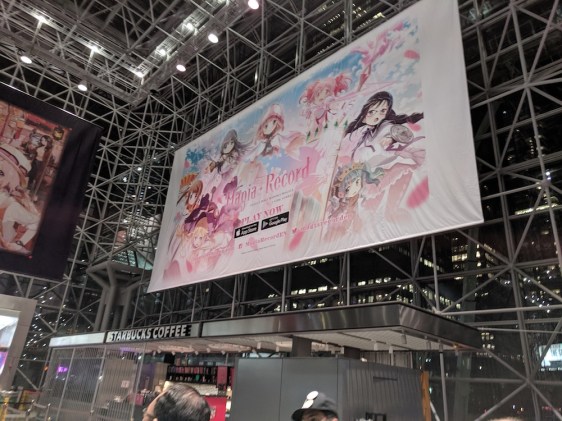
For the third year straight, Anime NYC 2019 has continued to fill a much-needed void as a New York Metropolitan-centric major anime and manga convention that is run by experienced professionals.

More of the Javits Center was taken up by the con compared to previous years, implying continued growth. While it’s not as large as New York Comic Con, and there’s a bit of an upper limit as to how many dedicated otaku are in the NYC area versus how many comics fans there are, I don’t mind the current balance. One of the strengths and weaknesses of NYCC is that it’s extremely broad and seems more like a general nerd multimedia convention than one dedicated to its core concept of comics and comics-related things. With Anime NYC, however, it still feels like an event dedicated to anime and manga fans fire and foremost. That alone is much appreciated.

The Guests

The guests this year were pretty much straight out of my dream list. Sadly, due to both personal obligations and just the sheer amount of overlapping content, I couldn’t even see everything I wanted to. On the fortunate side, however, I got to attend both the premiere of the first Gundam Reconguista in G film and a press Q&A with the tsundere master herself, Kugimiya Rie. You can check out Ogiue Maniax’s dedicated entries to both of those in the accompanying links.

Anime NYC 2019 went with a pre-show lottery system for getting autograph tickets as a way to prevent people from trying to line up at 3am in the morning and to give a fair chance to those who are coming from far away or don’t have the means or ability to get to the convention extra-early. Despite the fact that I didn’t get any autographs, I didn’t mind this system because it seems to be about as fair as it gets.

Alternately, some autographs could be obtained through purchasing specific products at the start of each day. There were also the $125 Kugimiya autographs that sold out in literally about five minutes, but Anime NYC 2019 was her first US appearance, so that was more or less expected.

That said, I’m not especially fond of the trend I’m seeing at Anime NYC where guests will only sign things from the shows they’re at the convention to promote. I understand why it happens, given that the guests coming want to make sure that the works they’re being advertised for get top billing, but these industry names often have such long CVs that it’s a shame when fans aren’t be able to express love for the particular things they feel closest to. For example, wanted to get autographs from Yukana and Kimura Takahiro, one of my favorite voice actors and character designers, respectively. But rather than being able to have my Pretty Cure and Gaogaigar signed, their autographs were tied to Code Geass—a series I don’t have quite as much affection for. Limiting what can be signed (aside from obvious things like “no bootleg merchandise”) is a direction I’d like to see conventions move away from in general, even more than paid autographs.

Exhibitor’s Hall and Artist Alley

I did not end up buying much at the convention—a t-shirt here, a manga there—but from what I could tell, it was not especially difficult to navigate in terms of foot traffic. At times, it could be difficult to tell which row corresponded to what designated section, but it was manageable. They also placed the Artist Alley in the same space as the Exhibitor’s Hall this year, which meant the loss of the third-floor space but maybe more reliable crossover traffic for both the big companies and the small artists.

One new feature was a special food area in addition to the food trucks outside and the food court down in the bottom level. It was a great idea in principle, but the prices seemed a bit ridiculous even for convention standards. Go Go Curry (aka my favorite Japanese curry chain ever) was the star of the show, but the line was so constantly massive that I never had time to try their convention-exclusive fried-egg-on-gyudon curry. Here’s to hoping that it becomes a standard item on the Go Go Curry menu!

Lantis Matsuri

I was incredibly pumped to attend Lantis Matsuri at Anime NYC this year, as it had an impressive lineup of musical guests: JAM Project, Guilty Kiss from Love Live! Sunshine!!, TRUE, and Zaq. Months prior, I swooped in on a ticket as soon as they became available, and I’m glad that they eventually opened up more tickets for those who couldn’t get the initial ones. I wonder if they were hedging their bets, and trying to see if the demand would be there for more.

When it comes to attending anime music concerts, part of the fun is song familiarity and being able to enjoy your favorite themes live. But even for the less familiar tunes, Lantis Matsuri hit it out of the park. All the singers were fantastic, and really felt like they belonged on that stage. Guilty Kiss clearly had the largest fanbase there, and their hype was well deserved. I still have “New Romantic Sailors” stuck in my head. TRUE and Zaq ended with their best-known hits, “Dream Solister” from Sound! Euphonium and “Sparkling Daydream” from Love, Chunibyo & Other Delusions. It was not lost on the audience that these were both Kyoto Animation series themes.

Despite the stiff competition, however, JAM Project showed they they know how to steal a show There’s something about their energy that draws you in that outshines even the brightest stars. I have to wonder how someone completely unfamiliar with them felt about their performance. They led with One Punch Man to get the crowd to realize just exactly who they are, but they also made sure to include songs less widely known by the general audience. Of particular note is their blend of GONG and SKILL, which combined two of their best Super Robot Wars themes.

There were multiple collaborations throughout the concert, and one sticks out to me above all: JAM Project with Guilty Kiss doing the second opening from GARO. Before the concert began, someone near me was expressing their love of GARO, and seeing him scream wide-eyed as JAM Project announced that the next song was “Savior in the Dark” was a real highlight of the con.

My only complaint about the concert was that the audio was a little too loud. I was not sitting especially close to the speakers, but I could feel my ears ringing the next day. I also had this problem at the Gundam Reconguista in G showing, so I have to wonder if it was a convention-wide issue.

Overall

I thought Anime NYC 2019 was great, and I’m looking forward to next year. As the convention gets bigger, though, I hope it continues to properly straddle the line between big professional expo and intimate-feeling fan-oriented gathering. It might be an impossible task, but I still want that dream nevertheless.

Bite Me: Yofukashi no Uta Initial Impressions

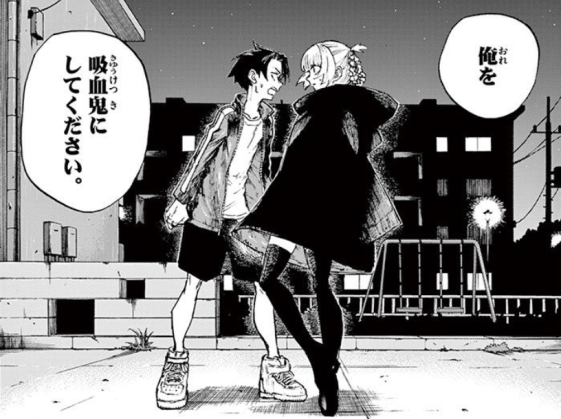
Kotoyama, the author of Japanese snack-themed manga Dagashi Kashi has a new manga: Yofukashi no Uta (“Song of Staying Up Late”), named after a song by the band Creepy Nuts. Eschewing a specific focus on a product or gimmick this time, Yofukashi no Uta maintains a similarly entertaining and humorous format of back-and-forth banter, a mysterious girl who seems out of this world, and a boy who feels stuck in place.
Yamori Kou has been having trouble sleeping lately, as if he’s missing something. His malaise causes him to inadvertently push friends away, and he wanders around at night aimlessly. He meets a girl, Nanakusa Nazuna, who seems to enjoy the evening hours with a cheerful and gregarious attitude, but who turns out to be a vampire. Nazuna gets a taste of Kou’s blood, which turns out to be unusually delicious, and after some conversation, Kou decides he wants to be a vampire himself. However, in order to be turned, he must fall in love with her.

The basic dynamic between Kou and Nazuna is that Kou is okay talking about romance but gets easily embarrassed when discussing raunchier topics, whereas Nazuna is the opposite. Their contrast is fairly similar Kokonotsu’s and Hotaru’s from Dagashi Kashi, but without the focal point provided by candy as a consistent topic. I admit that I do miss the dagashi talk, but I also understand that that can’t just retread old ground. And the way Kotoyama writes character interactions is still charming, so it’s in good hands.

One big difference between Yofukashi no Uta and Dagashi Kashi is chapter length. Whereas the latter tended to be only about eight pages or so, the former is more standard shounen manga size. It gives the manga more room to breathe, and I’m curious to see how Kotoyama does over time with more space.

I’m going to try and keep up with the series however I can. With Volume 1 on sale in Japan November 18 (along with a Dagashi Kashi collection of artwork), it’ll be a great opportunity.


It Was Me, Jin! It Was Me All Along!: Hashikko Ensemble, Chapter 20

Why fight when you can sing? It’s Hashikko Ensemble Chapter 20!

Summary

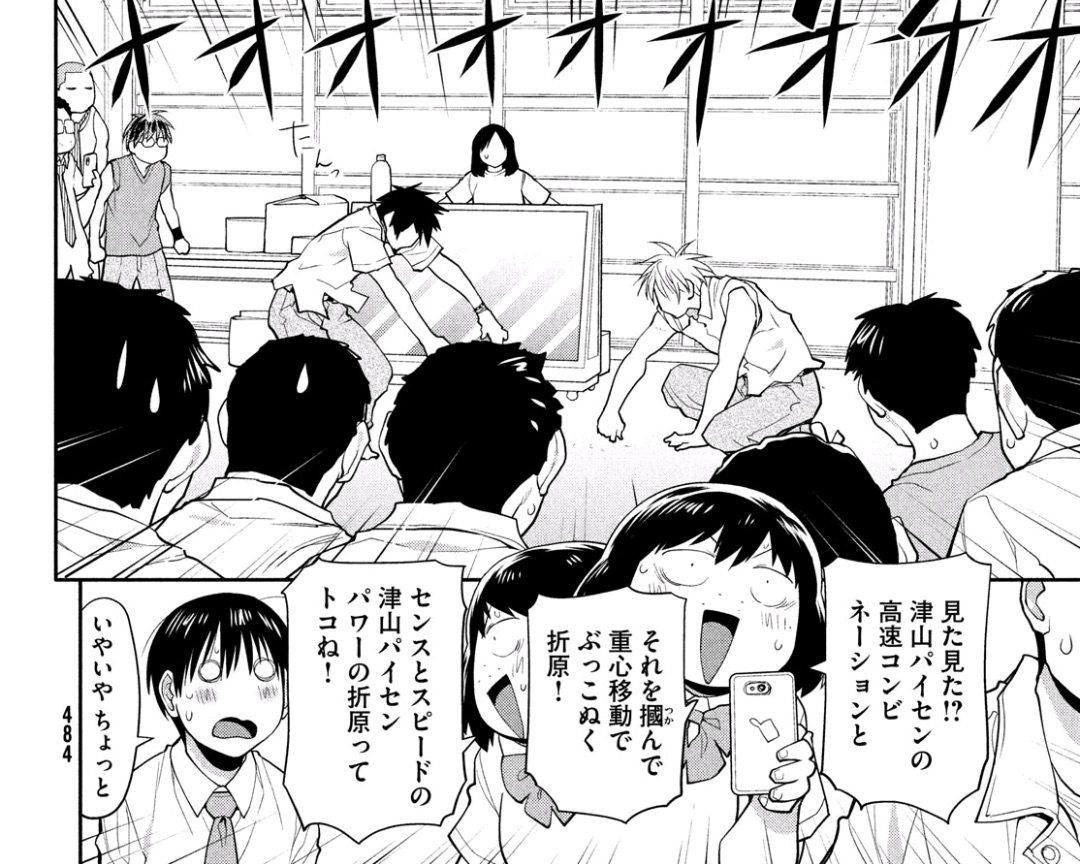
Tsuyama (of the Mimi-sensei-loving quartet) and Orihara fight under the former’s mistaken belief that the latter sexually assaulted Mimi-sensei. Evenly matched, the situation is eventually defused when Mimi-sensei herself explains that nothing happened and Hasegawa lied about Orihara squeezing Mimi-sensei’s breasts. Tsuyama and his friends still discover it’s Shion who’s the true “culprit,” but at least a couple of them don’t seem to mind at all.

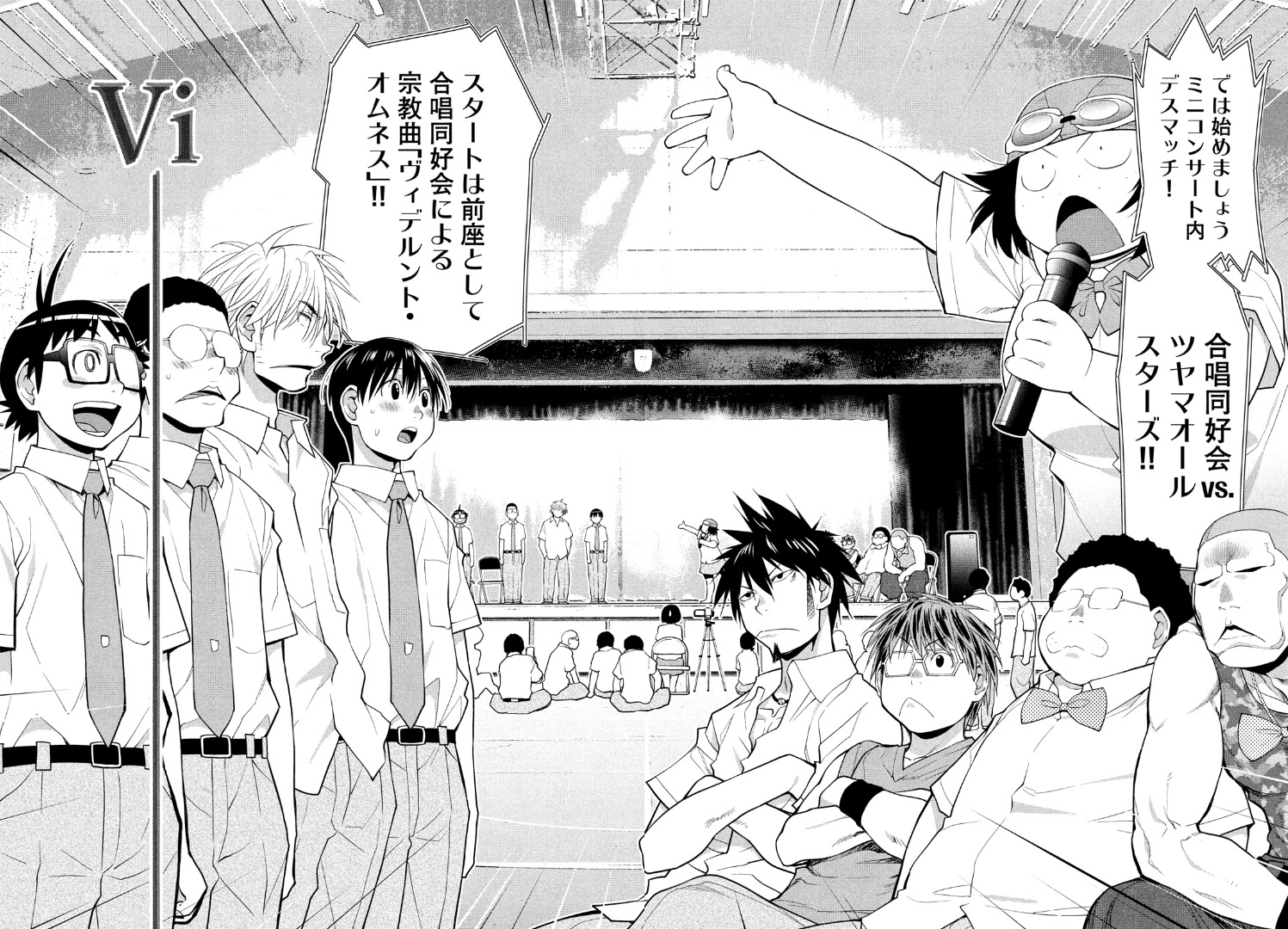
Jin uses the audience gathered from the fight to his advantage, and suddenly announces a 4 vs. 4 singing competition between the Chorus Appreciation Society and Tsuyama’s group.

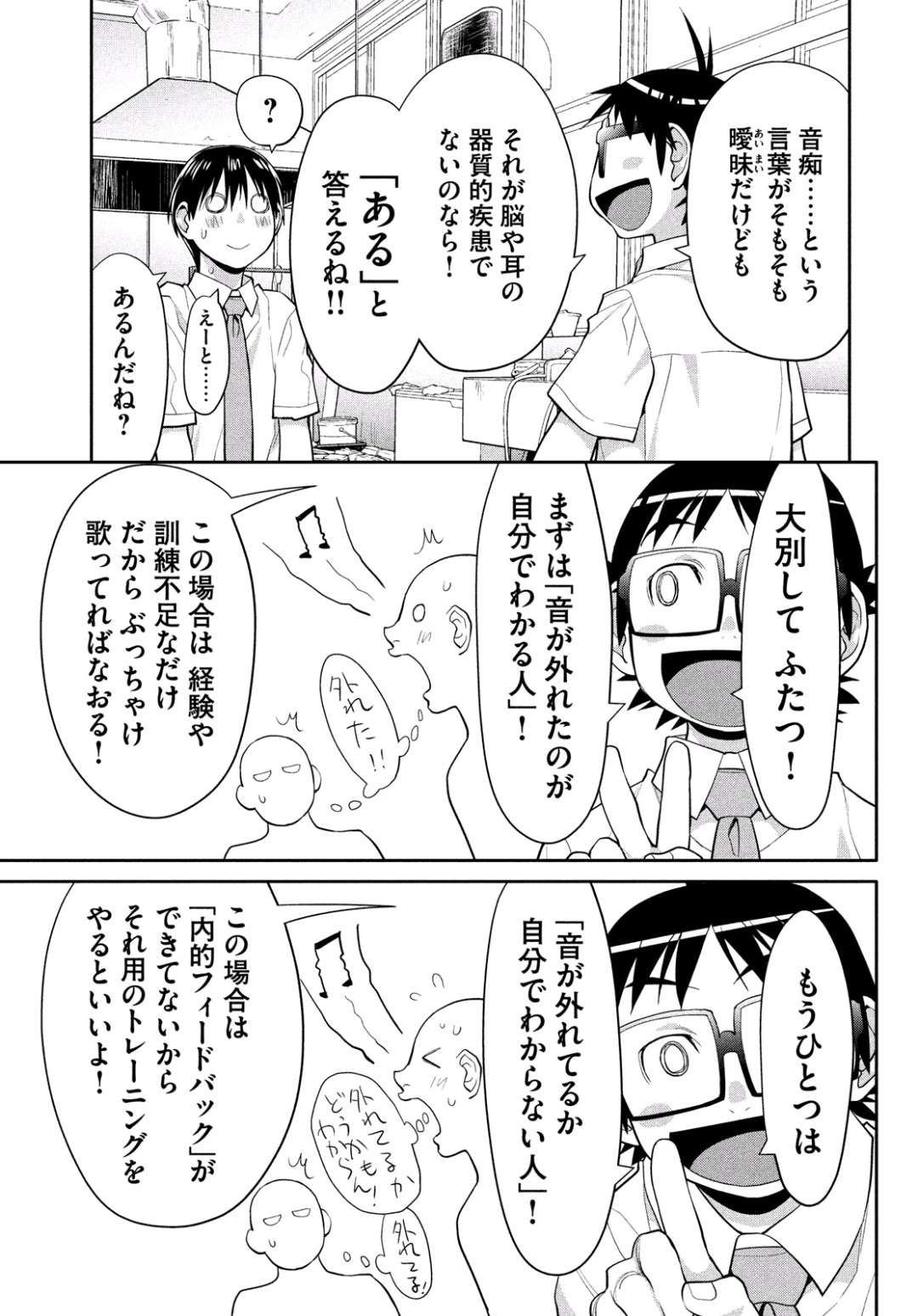
We learn in a flashback that Tsuyama is actually a pretty good singer, but they’re not exactly ready for this contest. The music teacher Takano-sensei offers to help them. Also, unbeknownst to his friends, the gorilla-like Ogawa (nickname “Ogre”), goes to the Chorus Appreciation Society for help in learning how to sing better. The reason: he doesn’t want to hold the others back. Jin begins teaching him about how to deal with being out of tune.

Back in the present, Tsuyama’s group are about to sing “Cherry” by the Japanese pop group Spitz (Mimi-sensei’s favorite band) against the Chorus Appreciation Society’s “Viderunt Omnes,” when suddenly, Ogawa hands his microphone over to Akira, in what looks to be a shocking betrayal!

Not the Best Handling of Rape as a Subject

I want to preface this minor criticism by saying that I don’t think Kio Shimoku is trivializing or supporting rape in any way, and what I sense from the story is that this little fiasco is more about a false rumor run rampant. Hasegawa, for her part, didn’t even say the word okashita (variously “rape,” “violated,” etc.)–it was Tsuyama who interpreted it that way.

However, given the increasing awareness we as people have about women not being believed when it comes to sexual assault, having a girl like Hasegawa start this rumor is not the best look for the series. For me, it’s not a deal breaker, and I still love the heck out of Hashikko Ensemble, but it’s potentially playing with fire.

Anyone Can Improve Their Singing

Jin makes a helpful point this chapter about how getting better at singing in tune depends on how tone deaf someone is. A person who can recognize that they’re not singing well can, over time, learn to adjust. Someone who is tone deaf, on the other hand, will need another person to tell them when they’re off, but this can still be a path to improvement.

It gives hope to folks like me who are musically challenged.

Friendship Between Misfits

While I originally thought that Tsuyama and his friends might become antagonists of sorts, that doesn’t seem to be the case. Instead, what I see is a group of people who are kind of weird and arguably pretty creepy, but who have one another’s backs. I find it touching that Ogawa thinks so highly of Tsuyama (who encouraged him to work out so that no one could belittle him) that he would go to the enemy for help in learning how to sing. In a way, it’s like these guys are the cast of Genshiken, only all of them are like 10-15% Kuchiki. The clear path is for at least some of these guys to eventually join the Chorus Appreciation Society, but I wouldn’t be surprised at a few twists and turns.

Also, the fact that two of them are into yuri but two of them don’t seem to care that much makes for a small but interesting distinction among their group.

Songs

As Mimi-sensei talks about her fondness for Spitz, the following songs get mentioned:

“Cherry”

“Robinson”

“Sora o Toberu hazu” (“You’ve Gotta Be Able to Fly”)

“Viderunt Omnes” is also brought up again. Orihara basically refused to sing anything else.

Final Thoughts

Despite all the weirdness with Hasegawa, her running commentary for the Orihara-Tsuyama fight is a highlight of this chapter. The way she compares Orihara’s enormous strength to Tsuyama’s speed and technique fills me with glee.

I highly doubt that Akira is doing any sort of real heel turn, but I’m looking forward to how it pans out. I assume that friendship will win over all, and Shion will gain some strange new guardians.

Masaka Fall in Fall Dato?!: Ogiue Maniax Status Update for September 2019

As autumn comes around once more, and the summer hear theoretically wanes (oh, that climate change), I’d like to say “thank you” to my supporters on Patreon and ko-fi.

General:

Johnny Trovato

Ko Ransom

Diogo Prado

Alex

Sue Hopkins fans:

Serxeid

Hato Kenjirou fans:

Elizabeth

Yajima Mirei fans:

Machi-Kurada

Highlights from August:

At Otakon 2019, got the opportunity to interview with two Japanese voice acting greats, Furuya Toru and Inoue Kikuko. Both of them went great, and I highly encourage everyone, but especially Gundam fans to read them.

And I guess it was a very Gundam month, as I also wrote a piece about my intersecting thoughts between G Gundam and the current state of Hong Kong.

Hashikko Ensemble

Chapter 19 introduces a bunch of new and possibly antagonistic characters, expanding the Hashikko universe a little more.

Patreon-Sponsored

My Favorite Switch Games is pretty self-explanatory.

Closing

This month’s blog coverage is kind of dominated by Otakon, but that’s sort of an inevitability with it being such a big event, and one where I feel that I get the best coverage for interviews and the like. My plan is to do more anime and manga reviews/analyses, as well as a few unexpected topics.

I’m also considering simplifying my Patreon sponsor tiers, as the number gags I introduced to reflect Genshiken fandom might make the whole thing too unwieldy for newcomers. If anyone has thoughts on this, I’d like to hear.


Problematic Fans: Hashikko Ensemble, Chapter 19

I forgot to mention it last month, but the series has a Twitter account @hashikko_music. Also, Volume 3 is coming out September 20th!

With that out of the way, on to Chapter 19 of Hashikko Ensemble, titled “God is Dead.”

(I was thinking of adding the chapter title in these reviews. What do you think?)

Chapter Summary

The Hashimoto Chorus Appreciation Society has left Nishigafuchi, and they’ve taken away different lessons. Mimi-sensei discovers that the M-Con doesn’t require conductors, so her training and practice were unnecessary. Shinji finds out that extensive singing can really work out the stomach muscles to the point of pain. And Shion is reminded of how the memory of squeezing Mimi-sensei’s boobs is the key to her keeping her grip soft when playing piano.

In the clubroom, as Jin explains to everyone Nishigafuchi’s ability to minimize the amount of noise in their singing, Himari makes an appearance to deliver Orihara’s earphones, which she’s finally repaired. However, Himari is shocked to see the number of girls there, and after some awkward fumbling while handing over the earphones to Akira, the sheer amount of blushing going on triggers Hasegawa’s romance radar.

Meanwhile, as Mimi-sensei is advising the Volleyball (she wears many hats at school), we’re introduced to a kind of unofficial Mimi-sensei fan club. Its four members hold a grudge against the Chorus Appreciation Society because they’ve heard a rumor that one of the members has squeezed Mimi-sensei’s breasts, though they assume it’s one of the guys. They confront Akira and threaten him to tell them their target’s identity, but Akira, not wanting Shion to get hurt, decides to pretend that he’s the culprit.

However, Hasegawa interrupts and claims that Orihara is the one they’re looking for, even exaggerating the story to be extra obscene and extra gropey to troll them. Hasegawa reasons that they wouldn’t mess with Orihara, and this would end their whole endeavor. Unfortunately, she turns out to be very wrong, and one of the members tries to get into a fight with Orihara. Not long after, a teacher bursts into the faculty office and informs Mimi-sensei of a rumor that she was raped by Orihara, which causes her to do a literal spit take.

The Mimi-sensei Fan Club

The four members–Muro, Naga, Ouga, and Tsuyama–all seem to resemble animals, but I can’t for the life of me figure out if it’s supposed to be a specific reference. They don’t seem to fit Journey to the West, Momotaro, or the Four Symbols. If anyone knows what they could be, I’d be interested to know.

In addition, I like that the chapter points out how this little quartet is viewed with some disdain by other members of the school. They kind of come off as creeps, and you can practically hear the utter loathing in the voices of the Volleyball Club members when the four visit the club’s practice just to see Mimi-sensei. One of the members even calls Mimi “Mimi-kami-sama,” and they’re all obsessed with her large breasts, even more than the rest of the boys in the school. For some reason, they like to compare her boobs to different insect-like creatures, including pillbugs and large crustaceans known as Bathynomus giganteus. Doesn’t exactly sound hot, but…

Shion is the closest thing Hashikko Ensemble has had to antagonists thus far, so I have to wonder if they’ll somehow fulfill that function. Knowing the manga, though, I bet at least one or two (if not all of them) will somehow end up joining the main cast.

Another New Character! What Could It Mean?

The reason why Hasegawa is able to rescue Akira in time is because another classmate, Kurotaki Mai, mentioned the incident. Apparently, she relates to Akira because she also has an unusually deep voice, though Hasegawa thinks it might be something more. In fact, between Mai and Himari, Hasegawa has the impression that Akira is some kind of unrealized Casanova.

Speaking of Himari, I was wondering when she would show up again. The fact that she reacts with such shock at the amount of girls in their clubroom makes me wonder if she’s more nervous around other girls than guys. There’s a lot we still don’t know about her, but she does come across as shy and reticent.

There’s an amusing gag where both Hasegawa and Himari think of the other as looking mean, despite or perhaps because the two have different personalities. Is that another friendship in the making? And could Mai’s deep voice somehow land her in the Chorus Appreciation Society?

Deep Breath Languages and Non-Integer Overtones

I wonder what languages count as ones that require deep breaths. I only speak a few languages myself, and I can’t seem to think of any of them as requiring extensive use of deep breaths or strong use of stomach muscles. It’s a topic I’m fascinated to learn more about–I just wish I knew where to start!

Jin also explains that the key to the beautiful harmony that Nishigafuchi is capable of has to do with “non-integer overtones,” a term I don’t fully understand, but seems to imply an unusual harmonics of some kind. As Shion comments, it’s a difficult word even in Japanese (非整数次倍音, hiseisuujibaion). It appears to be more common of a term in audio engineering, which also speaks to Jin being the biggest sound nerd there is. I guess you could describe him as an audiophile, but that word doesn’t quite fit all the way, as he cares less about audio equipment and more about the science of sound and its interactions with the art of singing.

Wonder Cooooore!

There’s a weird gag in this chapter where the word “Wonder Coooore” keeps getting censored. It turns out that Wonder Core is an exercise machine promoted on Japanese TV.

It’s advertised around the world, including in the US through the Home Shopping Network, but it’s not nearly as funny or interesting.

Songs

No songs this month. Only conflict!!!

Final Thoughts

It’s a minefield to touch on the topic of rape in a joking matter, even if it all comes out of an elaborate misunderstanding (plus intentional obfuscation). I have faith that Kio won’t do anything truly in poor taste, but I still wanted to express some concern. We’ll have to see with the next chapter.

Amuro and Aina’s Excellent Adventures: Otakon 2019

Otakon has long been the anime convention I look forward to most every year. I like how it’s always had an great balance between fan and industry where neither side feels neglected, as well as a panel track that encourages in-depth exploration of topics. This year was no exception, with both great guests and a variety of interesting fan panels. Otakon has also settled into the Walter E. Washington Convention Center quite comfortably at this point, and I have few if any complaints about the logistics of the actual location. The only gaffe I will point out is that there’s still a good deal of miscommunication when it comes to autograph lines, but other than that, it was pretty smooth sailing.

With that said, on to the rest of the con report!

Interviews

I conducted interviews with two voice actors at Otakon: industry veteran Inoue Kikuko (Belldandy, Aina Sahalin, Kazami Mizuho) and legend Furuya Toru (Amuro Ray, Tuxedo Mask, Pegasus Seiya). They’ve been getting some traction on Japanese Twitter, which I find thrilling.

As an aside, I love the press area at Otakon in DC. Not only is it a prime cosplay photography space, making it a lively aspect of the con, but it’s so much more convenient than the old one, and makes it significantly easier to schedule activities.

Panels

Frequent Otakon guest and anime industry super veteran Maruyama Masao had a couple of panels where he went through pretty much every anime he’s ever produced. Most of it was fairly mainstream work from his three studios—Madhouse, Mappa, and M2—but there were a few rare gems like a short by Rintaro and Otomo about them bicycle racing each other. He also mentioned at what point he first started working with various directors and creators. Another thing I came away with was how the sex-and-violence-laden Kawajiri Yoshiaki OVAs of the 80s and 90s had hilarious trailers that would abruptly shift from non-stop action to claiming a beautiful love story was in there, complete with cheesy romantic pop.

Anime in Non-Anime was a fun and entertaining panel from Anime World Order‘s Gerald. Not only was it full of laughs, especially when it came to the news coverage of the Naruto run for the Storming Area 51 Facebook group, but it put into perspective how deceptively large the anime industry really is in terms of reach.

Am I Too Old for This? was a pleasant surprise. Rather than being nostalgic commiseration or an empty pep talk, the panel was an informed look at how the concept of adulthood can coexist with the seeming childishness of fandom. The main takeaway was that managing responsibility, whether that’s taking care of yourself or others (or acknowledging when you need help from others), is the contemporary benchmark of adulthood, and that fandom is compatible with this. There was also an important point about not revealing your power level immediately to uninitiated acquaintances, because you have to deal with the reality of how anime fans are perceived in general society.

Animation in Anime by Evan Minto and Nate A.M. was a varied look at both the history and implementation of conveying the illusion of movement in Japanese animation. I think the panel did a good job of dispelling the notion that there is only one good way to animate, and detailing how the particular challenges of animating in Japan (primarily budget and labor issues) resulted in creators having to do more with less. I wonder how many people came out of it eager to learn about legendary animator Kanada Yoshinori, whose distinct style lives on in the likes of Obari Masami, Studio Trigger, and others.

In 20 Years Ago: Anime in 1999 Daryl Surat of Anime World Order looked back on the year 1999, and the fact that it’s been twenty years alarms and frightens me. Regardless of my own insecurity over the passage of time, it was an effective panel at putting anime’s history into perspective. Some tech hiccups interfered with the panel somewhat, but it didn’t impact the overall enjoyment. He also showed a willingness to not put creators on an unnecessary pedestal, as he called out a famous director who likely exploited one of his voice actors.

My Panels

Nine years ago, I did a panel about this blog’s namesake, Ogiue from Genshiken, and since then, I hadn’t touched my favorite manga as a panel topic prior to Otakon 2019. But thanks to a series of rereleases of Kio Shimoku’s older manga, I was inspired to do a panel that didn’t just cover Kio’s most famous title but his entire manga career. Thus was born Genshiken & Beyond: The Works of Kio Shimoku.

Creator spotlights are not the most popular panels, so there wasn’t a large audience at first, and the next panel being JoJo’s meant those seated at the end weren’t necessarily there to see me, but I think I accomplished what I wanted in going over Kio’s varied and daring manga works. To my pleasant surprise, I even won over a harsh critic on the Otakon feedback forums.

I had a second panel as well, Star-Crossed Alien Lovers…in Robots! with Patz from The Cockpit and Alain from Reverse Thieves. It was a more relaxed panel than my Kio one, and was built around looking at various robot anime that highlight romance amid conflict. My hope is that the panel got people thinking, even a little.

For those who attended my panels, thank you, and I hope to see you next year. I’ve got some ideas in the works…!

Bradio Concert

Having watched the anime Death Parade and enjoyed its high-energy opening theme, I was looking forward to Bradio’s live performance at Otakon, and it delivered in spades. Their attitude and presentation drew me in, and their unique jazz/funk/disco-fusion style is hard not to enjoy. I loved the hell out of every song, and it’s clear the crowd did too, as I could see people practically compelled to dance to the groove. Bradio’s irresistible music is made all the better by the singer’s excellent vocals and sheer range—he pretty much did one song entirely in falsetto without losing any power.

I would see Bradio again, no doubt.

As an aside, I stopped in briefly for the Nujabes Tribute Concert, but wasn’t able to stay long enough to get a good idea of it overall.

Other Notes

I briefly stopped by the Saturday Morning Cartoons subtitled video room. Along with the dubbed video room, the idea was to replicat watching anime from the 90s with commercials. I watched Sailor Moon in Japanese, and like with so many other shows with a merchandise engine behind them, there were tons of Sailor Moon commercials during the actual show. I also got to see a commercial starring the best video game mascot ever: Segata Sanshiro. If I had more time, I would’ve liked to stay there a bit more.

Also, shout-outs to the dealer’s room booth that was selling Precure, Doremi, and classic magical girl stuff I got this fine piece of Princess Comet/Cosmic Baton Girl Comet-san merchandise, and I was definitely tempted to get more. A rare find!

And lastly, some cosplay.

We Never Learn: What’s Best vs. What Results in the Greatest Happiness

The two main heroines of the manga We Never Learn have a dilemma. Each is a natural genius in a specific field, but both of them want to specialize in a subject that is their Achilles’ heel. If they play to their strengths, they will have easier lives, and they might even change the world. But their hearts lie in their weak areas, leading to a conflict potentially familiar to many: what’s “best” for them isn’t necessarily what will make them “happiest.”

I think elements like this are why the series has succeeded in maintaining my interest. It’s an understandable struggle that goes beyond the basic harem fanservice qualities of the manga and anime, and while exaggerated for comedic purposes, is something that plenty of people both inside and outside of Japan have to deal with. Do you pursue the impossible dream, do you aim for stability, or do you try to find a middle point? If you achieve less but enjoy the struggle more, is it worthwhile?

It’s clear that We Never Learn supports is characters long-odds pursuits, even as the culture around the manga often says otherwise. I’m not entirely sure if there’s a deeper message overall, but it’s at least one that resonates with anyone who’s had to deal with the conflict between inner hopes and outer expectations.


Kyoto Animation: Ogiue Maniax Status Update for August 2019

What should have been a delightful month of convention goodness took a turn for the sorrowful due to the deaths and injuries inflicted upon Kyoto Animation. Recent news has mentioned that their server data was recovered intact and that most of their old series are archived elsewhere, granting a silver lining to an otherwise dark and cloudy July. It’s no replacement for the loss of so many lives, but it’s something.

In terms of the blog itself, I’m back from Otakon, and you can expect a couple of interviews with Japanese voice actors Furuya Toru and Inoue Kikuko, as well as an overall con report.

Thank you again to my sponsors on Patreon and ko-fi.

General:

Johnny Trovato

Ko Ransom

Diogo Prado

Alex

Sue Hopkins fans:

Serxeid

Hato Kenjirou fans:

Elizabeth

Yajima Mirei fans:

Machi-Kurada

Highlights from July:

In honor of Kyoto Animation, I’m spotlighting the two posts I wrote this past month related to them.

Thoughts on the Kyoto Animation Tragedy

Locking Horns: Sound! Euphonium – Our Promise: A Brand New Day Review

Another sad moment also hit when Geoff “iNcontrol” Robinson of StarCraft fame died suddenly at the age of 33. I never met him personally, but I felt it harder than I expected to.

Hashikko Ensemble

Chapter 18 is a breakthrough moment for the Chorus Appreciation Society.

Patreon-Sponsored

Takamachi Nanoha: Transcending Yet Beholden to Her Childhood

My thoughts on the heroine of Magical Girl Lyrical Nanoha.

Closing

On the upside, the new Smash Bros. character is out, and he’s a ton of fun. The randomness of some of his moves is causing a good deal of debate, and I’m considering writing something about him with respect to this minor controversy.

Also, EVO starts today, with Smash Bros. Ultimate as the Sunday main event! What a time we live in.