Spider-Asuka and Her Amazing Friends: Aikatsu on Parade! Halloween

Though a little out of season, I’m going to be fulfilling a Patreon request and continuing the All Hallow’s Eve-themed anime posts from September. Here’s a look at Aikatsu on Parade! episode 5, “Lucky Halloween.”

Kiseki Raki and friends are in the original Aikatsu! universe, where they enter an idol costume contest that naturally includes singing and dancing. Highlights are both the show and the characters giving Akari some props, and Mirai Asuka’s off-brand Spider-Man costume.

I’m not deeply connected with Aikatsu! fandom, but I somehow get the sense that Akari isn’t considered as memorable as other protagonists. In a sense, she’s like the Pretty Cure Splash Star of Aikatsu!, with the unenviable task of following the influential original. In this episode, all the characters express a kind of wonder and amazement at her, and there’s the feeling that she’s made a lot of progress relative to where she began—perhaps more than any other heroine.

As for Asuka, given her love of Halloween it makes perfect sense to make her a big part of the episode. Her impish attitude is a perfect fit, though she doesn’t seem as keen on trying to prank people here. Her choice of costume is undoubtedly memorable, and it makes clear that Spider-Man is now considered recognizable in Japan. Yes, there’s the old live-action Toei series with the giant robot and all that, but I suspect this is more because of the Marvel cinematic universe. The not-quite-the-same finger-point web-slinging is a nice touch.

I hadn’t thought about it before, but this is the first Aikatsu! Halloween with a costume contest. Pretty much every other one has been about tricks or games, so having another variation on how to celebrate the Holidays is interesting. As for Raki’s costume, which is basically a giant composite lucky charm, it’s very on-brand for her. I feel like a joke could be made where Raki turns into a luck-obsessed lunatic with a mindset similar to Gudako from Fate/Grand Order. Knowing Aikatsu!, it could actually happen.

There’s one glaring omission in this episode: it takes place in the original series but there’s no Yurika in sight. The vampire goth is pretty much synonymous with Halloween, so I wonder if they’re saving her for Halloween 2020. After all, it’s not unusual for an Aikatsu! anime to run for two years.

And who knows? Maybe we’ll see an off-brand Thanos next year.

This post is sponsored by Johnny Trovato through Patreon. If you’d like to request a topic, consider becoming a patron!
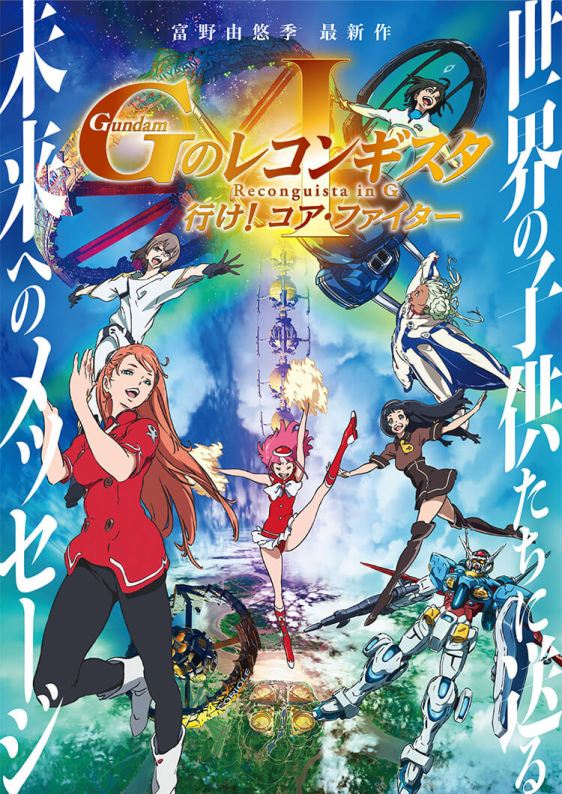
[Anime NYC 2019] Tomino’s Movie Magic: Gundam Reconguista in G Part I: Go! Core Fighter

At Anime NYC 2019, I attended the screening of Gundam Reconguista in G Part I: Go! Core Fighter, the first of five planned compilation films based on 2014’s Gundam: Reconguista in G TV series. It was one of the events I was looking forward to most at the convention, and not only because legendary Gundam director Tomino Yoshiyuki was there.

I am a staunch defender of G-Reco because I believe that in spite of its flaws, it has a strong anti-war message which surpasses even the original Gundam‘s in certain respects. Its setting, in an era after the original Gundam timeline, shows what war is like when the cataclysmic devastation of the past is all but forgotten, for better or worse. But I acknowledge that G-Reco did not exactly take the world by storm, as it could be a confusing series, and Tomino’s  “throw you in the deep end” style of no-context dialogue did it no favors.

Thus, I came into the screening with the hope—albeit a tentative one—that these new movies could clean up the rough edges of the series enough to get its ideas and themes across effectively to a wider audience. After all, for every Mobile Suit Gundam trilogy, which is in many ways superior to its source material, there’s a Mobile Suit Z Gundam: A New Translation, which feels sloppily put together. However, I immediately noticed that the film is much clearer and easier to follow, allaying my fears.

There are two simple but major choices that make this first G-Reco film less convoluted. First is the decision to condense the series into films in the first place. Second is the heavier use of internal monologue to make character motivations more obvious.

Many of the scenes and plot points relevant to one another in the TV series could be episodes apart, and by the time something came up again, it was easy to forget what information had been communicated already. But in the movie version, everything is more tightly packed together such that ideas and threads are fresher in the memory. It’s easier to see how various aspects of the world-building fit together, and what potential they hold as the story unfolds.

In regards to characters’ inner minds, the TV series suffered from what seemed like constantly inconsistent actions from characters. They’d switch sides, kill those close to them seemingly without much regret, and just be generally difficult to follow or comprehend. The hero, Bellri Zenam, was especially obtuse. Now, however, there are multiple new scenes of characters expressing either through thought (and sometimes even voice) just how they’re feeling and how it’s affecting their decisions. While the film is still characteristically Tomino and can be full of puzzling dialogue, having it be undergirded by these inner monologues helps to prevent the characters from coming off as sociopaths.

The biggest surprise to me is how much better I understood the character of Noredo Nug, Bellri’s friend and possible love interest. Noredo believes in Bellri’s goodness even more than the man himself does, and she’s willing to defend him in this regard even when he won’t do it himself.

Before the screening began, Tomino said that everyone who came for a Gundam movie will be disappointed because this isn’t Gundam. It seems like a tongue in cheek comment, but I think he really meant it in a way. The message he’s trying to convey through G-Reco is trying to target a new audience that isn’t entrenched in the existing Gundam cultural juggernaut—most likely, that’s what stuff like Gundam UC is for.

Because I’ve seen the TV series, it was impossible for me to go in with fresh eyes Still, I strongly feel that this first G-Reco film is a much more refined work, and while it can still be a challenge to follow at times, it is a major step up. I also just recently rewatched Gundam F-91, and that movie just falls apart a third of the way through, whereas Go! Core Fighter was enjoyable and thought-provoking throughout. Provided nothing goes horribly awry with the sequels, I believe that the Mobile Suit Gundam Reconguista in G films will be the definitive version.


Twelve Blogdoms: Ogiue Maniax 12th Anniversary

It’s with joy and a healthy dose of disbelief that I celebrate today as the 12th anniversary of Ogiue Maniax. Nothing says it to me more than the fact that a part of me wonders, “Should I still be writing these yearly commemorative posts? I’ve done so many already!” But in the end, I am nevertheless compelled to keep these going, if only because they’re worthwhile markers on where the blog has come and gone over the past year and more.

This being 2019 and all, probably the thing that sticks out most to me is how there’s another decade of anime to reminisce about. I wrote a couple of posts all the way back in 2009, titled 2000-2009 Part 1: Looking Back and 2000-2009 Part 2: Looking Forward, where I gave my thoughts on the trends I saw coming and going into the next 10 years of anime and manga. There is a clear record of many (but of course not all) of my thoughts and feelings about what has transpired since, yet I still feel rather intimidated by doing a proper follow-up.

There’s the fact that the amount of anime coming out per year has continued to skyrocket, and that I do a terrible job of keeping my review archives updated. I’m also older, and the years start to blur together. Those aren’t the only factors, however. I want to again take all that I know and try to give the 2010s their due at the same time I try to predict the future of the 2020s, yet in a way I feel like I know less than ever. Certainly, there was the bravado of being a young and impetuous otaku in 2009 eager to get his thoughts out into the world, but I’m having to also contend with a realization that I’m increasingly falling out of the core demographics of generally popular anime and manga. That doesn’t mean I can’t enjoy them, and I think it’s silly for someone to believe themselves “too old or mature” for kids’ shows, but my age shows more than ever.

I remain somewhat optimistic that I’ll be able to see this through and produce something worth writing about in approximately a month’s time. Also, in a way, I’ve forced myself to be on notice by writing my 12th anniversary post to be about this topic. Will I be a Nostradame? Let’s see.

Next year, Ogiue Maniax is going to hit its teens, and what a time that will be.

Splatoon Lore is Best Lore

Thanks to the recent Haikalive Kyoto Mix concert for Splatoon, I’ve had kids and squids on the mind lately. As I listen to music from Squid Sisters and Off the Hook while reading fan wiki entries about the Splatoon world, I find myself appreciating its lore more and more. It’s just robust enough to foster imagination but the games and their story are not beholden to it in any major way.

One of my favorite examples of Splatoon lore details is Marina, the DJ from Off the Hook, and what we learn about her music in the Octo Expansion. First, why is she a DJ? The likely answer is because she’s an Octarian. As a member of the ostensibly antagonistic species of Splatoon, her upbringing is both implied and outright stated to be different from the squids. Not only is the Octarian leader a DJ whose music plays throughout their territory, but Marina herself was an engineering prodigy from a young age.

In the backstory to Splatoon, it’s shown that octopuses are more technologically advanced than the squids. The reason why they lost the war is simply due to happenstance—someone accidentally unplugged their greatest weapons. Marina comes from the environment, where she helped develop weapons. Pearl even mentions that Marina is responsible for the Shifty Station stages during Splatfests, all of which utilize Octarian technology. So not only is the most prominent musician of Marina’s culture a DJ, but the technical know-how of turntables, synthesizers, and the like would come easily to her.

Furthermore, when you talk to Marie from the Squid Sisters in singleplayer mode, she mentions that she doesn’t understand how Marina makes music just by spinning some plastic plates—one of many indicators that squids are generally not tech-savvy. There’s even a moment during Haikalive Kyoto Mix where Marie looks at Marina scratching vinyl with confusion and amazement. The very idea of being a DJ seems foreign to squids by default, to the extent that the only other known DJ besides Octavio and Marina is a fellow octopus in Dedf1sh.

What ultimately made Marina defect from the Octarians is hearing the Squid Sisters’ “Calimari Inkantation.” Whether the song actually has magical properties or if it’s a Macross-style culture shock, Marina expresses the feeling that this new music changed her life and her direction.

In one of the chatroom logs in the Octo Expansion, Pearl and Marina share their song demos from before they made it big. Marina’s is an early rendition of “Ebb and Flow,” the song that plays during Shifty Station matches. It’s recognizable even in early form, but there are aspects of this version that hint at Marina’s Octarian origins—especially the jingle that plays when you beat a stage in singleplayer. In other words, “Ebb and Flow” likely began as an attempt by Marina to make something similar to the Squid Sisters while also working from her own cultural background, a fusion of squid and octopus styles.

Marina occupies a space where two cultures, squid and octopus, intermingle. Her role as this immigrant of sorts who expresses her history and her desired future comes across in little moments and details. It’s in the dialogue, it’s in the music, and it’s in the little gaps where imagination dwells. It’s that approach which makes Splatoon lore so fascinating, but just light enough a touch that it doesn’t obscure the other great aspects about the game.

Marriage of God and Soul: Ogiue Maniax Status Update for November 2019

The monthly update actually completely slipped my mind this month, and it’s already Anime NYC! I feel like time is moving all too quickly, but it’s for all the right reasons.

Thank you again to all my Patreon sponsors, especially the following!

General:

Johnny Trovato

Ko Ransom

Diogo Prado

Alex

Sue Hopkins fans:

Serxeid

Hato Kenjirou fans:

Elizabeth

Yajima Mirei fans:

Machi-Kurada

Highlights from October:

Burn to Fight: Promare

Studio Trigger’s latest anime is a rewarding visual spectacle.

Banjo & Kazooie: The Ultimate Beginner Character

The third Smash Bros. Ultimate DLC character is also perfect for helping beginner’s grow into better players.

Pump Up the Jam: How Heavy Are the Dumbbells You Lift?

This anime about the gymis more than just fanservice.

Hashikko Ensemble

Chapter 21 plays out the (sort of) shocking twist of sudden betrayal (?).

Patreon-Sponsored

Ooh, Where Does This Door Go?: Aikatsu on Parade! Early Thoughts

The newest Aikatsu! series is a crossover of all previous seasons. How does it look?

Closing

Because of Anime NYC and so much more, November has generally been a very hectic month for both me and the blog. I’m hoping I have time next month to write some decade in review posts like I did ten years ago!


Anime NYC 2019 Hype Post, aka The Craziest, Most Incredible Guests

Anime NYC 2019 is only two days away, and I want to use this opportunity to talk about how amazing the guests are this year. I promise that this is not a paid or sponsored endorsement in any way—these are my genuine feelings, and my feeling is that the guest list this year is just virtually perfect.

First and foremost, you have the legendary director of Mobile Suit Gundam, Ideon, and Zambot 3, Tomino Yoshiyuki. I saw him 10 years ago at New York Anime Festival 2009, and I am eager to see his return. He’ll be showing the first Gundam: Reconguista in G film, and as a staunch defender of that series, I’ve gotta go see it.

Then there’s Kimura Takahiro, animator and character designer on Gaogaigar, Godannar, Betterman, Brigadoon, and Code Geass. He is one of my favorite character designers ever, and I’m so, so stoked for him to be in New York.

Speaking of Code Geass, the voice actor Yukana will be making her New York City debut. In addition to playing C.C. in Code Geass (aka the best character in that series), she’s also Teletha Testarossa in Full Metal Panic!, Li Meiling in Cardcaptor Sakura, and Cure White in Futari wa Pretty Cure!

But Yukana is not the only Cure who will be there, as Ise Mariya (Cure Lemonade from Yes! Pretty Cure 5) is coming to promote The Promised Neverland, where she plays Ray. The director of The Promised Neverland, Kanbe Mamoru, will also be at Anime NYC 2019. He’s also the director for one of my favorite anime ever, Cosmic Baton Girl Comet-san.

Megalo Box is an amazing anime and reinterpretation of Ashita no Joe, Moriyama Yo, and both the director and producer, Fujiyoshi Minako, will be attending.

And the Lantis Matsuri concert Friday night will feature both JAM Project and Guilty Kiss from Love Live! Sunshine!! Having now attended concerts for both groups, I’m pumped to see them again (and again and again in the future, hopefully). Nothing is as fantastic as JAM Project performing “SKILL,” and a part of me is sincerely hoping all the groups involved will join in for a rousing “WHOHhhHHoooHHHooOoooH.”

So see you all at Anime NYC, and I hope these guests get the star treatment they deserve.


The Charisma of Terry Bogard in Smash Bros.

Terry Bogard has arrived in Super Smash Bros. Ultimate on the heels of a 45-minute love letter from Masahiro Sakurai to SNK. I feel that it gave Terry the appropriate level of hype, but it’s his charismatic presence, both in personality and playstyle, that can turn even the sourest doubters into fans.

Without even getting into little story details, Terry’s general presentation just screams “cool guy with a fun attitude who knows how to get serious.” His look might be straight from the 1990s, but he somehow doesn’t feel dated. All of his little Engrishy quips, his cool-looking moves, and even his general standing pose all work together to make him the center of attention. As expected of an SNK character—even after the Neo Geo started being inferior hardware, the developers of The King of Fighters would put in some of their best sprite animation work. Ultimate captures that sentiment.

As for gameplay, Terry feels more fitting for Smash than Ryu and Ken. His burst-mobility specials all work in a platform fighter format, and you can practically picture Terry coolly accepting that he’s in this crazy crossover situation. In a way, he feels like a mix between Ryu and Captain Falcon: a traditional fighter who can suddenly close large distances and make opponents regret frivolous decisions, but who’s balanced out by a less than stellar air game. His ability to access Power Geyser and Buster Wolf after 100% is sure to be controversial, but Terry overall doesn’t feel overpowered.

Welcome to Smash, Terry Bogard. I hope to see you make one hell of a splash.


I’m Happy to Have Chihayafuru Season 3

The Chihayafuru anime is back after nearly six years, and I’m just thrilled. Rarely is there a series that so deftly balances interpersonal drama, the excitement of competition, and the effective portrayal of its characters through both of those aspects.

Chihayafuru is about playing karuta, a game based on matching cards to recited poetry. It looks like the kind of thing kids would play when they’re bored, and it is. However, the series does such a convincing job of making competitive karuta look like a fierce and deep game, and it does so without necessarily needing to go for an over-the-top presentation. There’s nothing like ancient Go ghosts, basketball powers, or ultra mahjong luck. The “powers” aren’t otherworldly, but rather play styles based on individual traits and personalities, with just a slight dramatic flair. Chihaya, the heroine, doesn’t have superhuman ears, but the idea that she has better hearing, and that it pushes her toward a more aggressive style makes sense. Her old friend Arata’s memorization is uncanny, but not beyond the realm of mortals, and the fact that his grandfather was a former king of karuta gives him ample reason to have spent time on the game.

When the series introduces new characters and potential rivals, it rarely feels contrived or as if certain characters are clearly there to take the loss. Whether they’re former queens, players from other high schools, or even small children, they feel very human, both through their personal motivations and idiosyncrasies, as well as through their play. A lot of series bank on having large casts, but Chihayafuru‘s maintains an intimate feel.

Here’s to another season, and the hopes that we’ll be getting lots of emotional intensity and bad t-shirts.

(All hail Shinobu.)


Bite Me: Yofukashi no Uta Initial Impressions

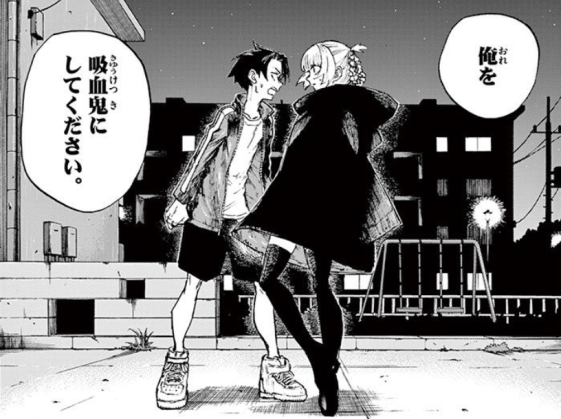
Kotoyama, the author of Japanese snack-themed manga Dagashi Kashi has a new manga: Yofukashi no Uta (“Song of Staying Up Late”), named after a song by the band Creepy Nuts. Eschewing a specific focus on a product or gimmick this time, Yofukashi no Uta maintains a similarly entertaining and humorous format of back-and-forth banter, a mysterious girl who seems out of this world, and a boy who feels stuck in place.

Yamori Kou has been having trouble sleeping lately, as if he’s missing something. His malaise causes him to inadvertently push friends away, and he wanders around at night aimlessly. He meets a girl, Nanakusa Nazuna, who seems to enjoy the evening hours with a cheerful and gregarious attitude, but who turns out to be a vampire. Nazuna gets a taste of Kou’s blood, which turns out to be unusually delicious, and after some conversation, Kou decides he wants to be a vampire himself. However, in order to be turned, he must fall in love with her.

The basic dynamic between Kou and Nazuna is that Kou is okay talking about romance but gets easily embarrassed when discussing raunchier topics, whereas Nazuna is the opposite. Their contrast is fairly similar Kokonotsu’s and Hotaru’s from Dagashi Kashi, but without the focal point provided by candy as a consistent topic. I admit that I do miss the dagashi talk, but I also understand that that can’t just retread old ground. And the way Kotoyama writes character interactions is still charming, so it’s in good hands.

One big difference between Yofukashi no Uta and Dagashi Kashi is chapter length. Whereas the latter tended to be only about eight pages or so, the former is more standard shounen manga size. It gives the manga more room to breathe, and I’m curious to see how Kotoyama does over time with more space.

I’m going to try and keep up with the series however I can. With Volume 1 on sale in Japan November 18 (along with a Dagashi Kashi collection of artwork), it’ll be a great opportunity.


Soul of Chogokin Gordian vs. Baikanfu and the Matryoshka Robot Legacy

In the world of giant robots, what you see traditionally has not always been what you get. The cool robot that appears in an anime might look significantly different from the toy it’s based on due to the fact that metal and plastic are limited by the physical world in ways drawings are not. The difference between the gimmick-laden early Gundam toys and the more show-faithful model kits that followed is a prime example. This disparity is why the announcement of the Soul of Chogokin Gordian is of particular interest to me, despite me not having much emotional investment.

When it comes to being true to both toy and anime sides, the Soul of Chogokin line of deluxe figures is arguably the best there is, and I have no doubt that they’ll faithfully reproduce the designs from the anime Gordian Warrior. By itself, this would be the story of an obscure 1970s series getting its due in the Soul of Chogokin line, but there’s an extra wrinkle—a child or clone twist, perhaps. There’s actually a robot toy that originally began as a repurposing of the Gordian Warrior line known as Baikanfu (or Vikungfu) from Machine Robo: Revenge of Cronos, and this particular robot was already made into an SoC figure back in 2007. Yet, because the associated anime are so aesthetically different from each other, this practically necessitates two different approaches.

Gordian Warrior has very little presence in the English-speaking world, as its toy came and went as part of the 1980s Godaikin line, and the anime’s only official release (streaming only) was by the now-defunct AnimeSols. Still, one look at the opening is all it takes to understand why the Gordian robots with their Matryoshka doll–like stacking gimmick would be fun and attractive toys. It’s likely why they were revived for Machine Robo: Revenge of Cronos, and when you see the toys from each anime side by side, the connection between the two series is all the more obvious.

But thanks to the magic of art and imagination, these two extremely similar toys end up being portrayed wildly differently on TV. In animation, the three Gordian robots—Protesser, Dellinger, and Garbin—have less exaggeratedly hypermasculine proportions compared to their Revenge of Cronos equivalents, Rom Stohl, Kenryu, and Baikanfu.

Despite Harbin being the biggest robot in Gordian Warrior, its simple blue and white color scheme and its slender body look downright austere compared to Baikanfu. And because the Soul of Chogokin line aims to embrace both the fun of the action figure and the style of the anime, it means getting to see how the same basic toy design ends up interpreted through two different lenses as prestige objects. Where will they differ? Where will they show commonality?

Gordian and Baikanfu are not the only example of designs being reused. One notable example is the Transformer Six Shot, a robot with stuff forms whose toy was repainted and resold as the ninja robot Shadowmaru from Brave Police J-Decker. Like the two stacking robots, Six Shot and Shadowmaru look so different in animation that it’s a surprise to find out their toys are virtually the same.

The Soul of Chogokin Gordian from Gordian Warrior is more than an opportunity for nostalgia, as it’s also a chance to look at how the same line has interpreted it’s design with respect to its spiritual successor in Baikanfu from Machine Robo: Revenge of Cronos. It’s ripe ground for appreciating some smart, nostalgic toy design along with the creative interpretation of toy to anime transitions.